“My apartment smells like the hallway.”
“I can smell my neighbor’s cooking.”
In multifamily buildings, complaints like these are usually not just about odor. They are often signs of an airflow problem.
Pressure imbalance, underperforming exhaust, stack effect, and outdoor air intake issues can all cause odors to flow where they shouldn’t. Odor complaints do more than frustrate residents. They also create repeat service calls, strain operations, and raise indoor air quality concerns.
The first step is to understand how the building is moving air and if the ventilation strategy is working the way it was intended.
Erdem Kokgil, Passive House Solutions Manager at Oxygen8, helps us understand common multifamily ventilation approaches and where they succeed or fail.
“In theory, there is no air migration between suites, but we’ve seen otherwise in real-life applications due to poor balancing.”
— Erdem Kokgil, Passive House Solutions Manager, Oxygen8
When determining an odor source, the first step should always be to follow safety precautions. If you experience signs of gas or chemical leaks, vehicle exhaust or smoke, escalate the problem immediately.
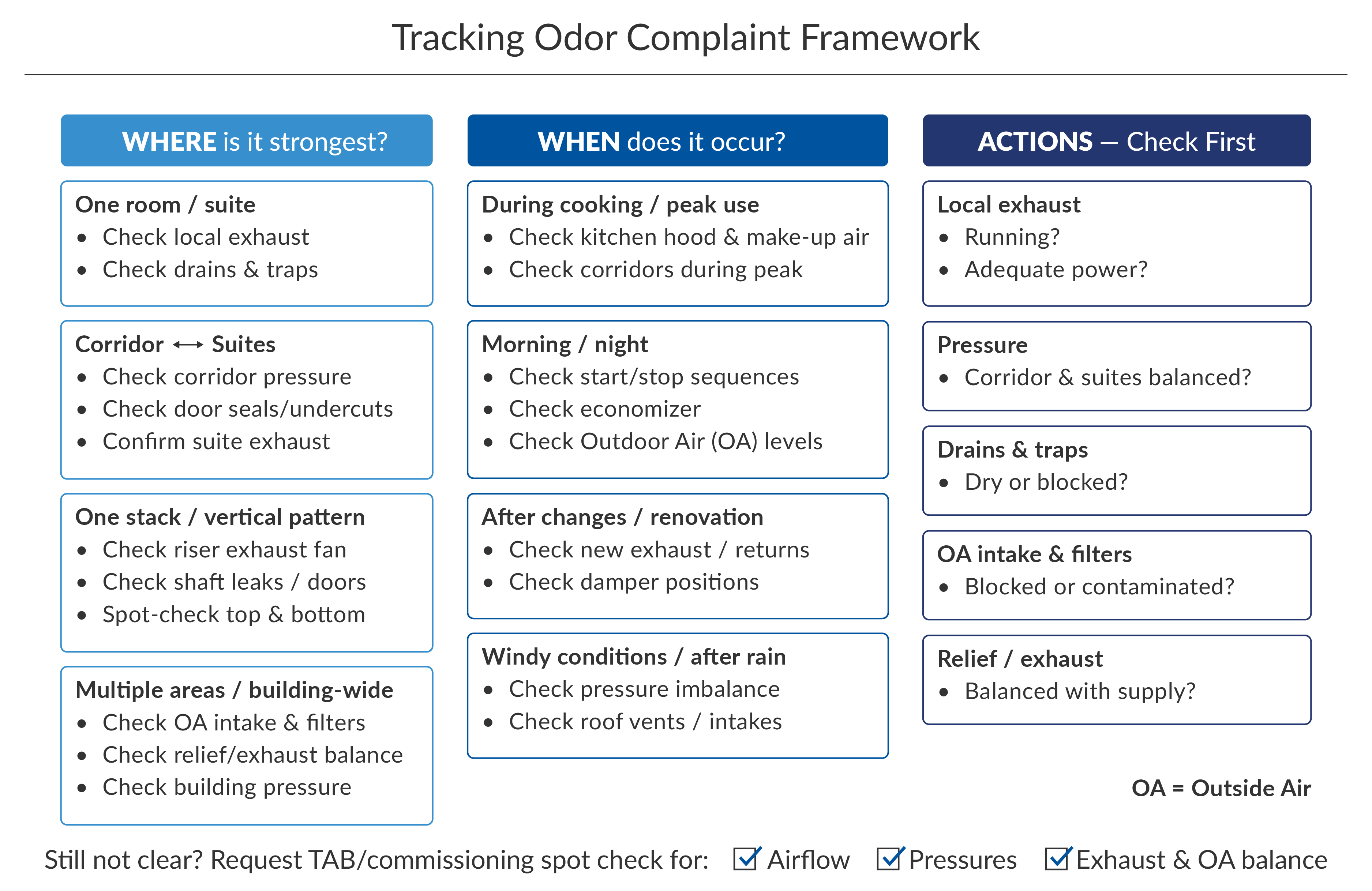
You have a complaint. Now what?
- Is exhaust actually moving the air (and not just “on”)?
- Is air moving in the intended direction at the door?
- Are Building Automation Systems shifting modes (warm-up/setback/economizer)?
If odors show up in multiple areas, check outside.
- Is there a loading dock/idle zone nearby?
- Is a kitchen exhaust or plumbing vent too close?
- Is a trash room exhaust recirculating?
A surprising number of mysterious odors are caused by the outdoor air intake pulling from a nearby source.
Why Odor Complaints in Multifamily Buildings Start with Pressure Imbalance
Most odor complaints in multifamily buildings are not just “a smell problem.” They are airflow problems.
If complaints are mostly corridor-to-suite (i.e. my unit smells like the hallway), the pressure relationship is likely flowing from the corridor into the suite. This is likely due to a difference in pressure between the spaces. Either the suite is negatively pressurized, or the corridor is over-pressurized.
Start by checking whether air is moving into the unit from the corridor or vice versa at the door gap, then confirm suite exhaust is pulling the way it should.
Many traditional multifamily designs rely on a simple airflow path:
- Ventilation air delivered to corridors (positive pressure)
- Exhaust pulled from bathrooms/kitchens in suites (negative pressure)
- Air moves into the suite under the door (positive → negative path)
This can work, but only if the building holds its intended pressure relationships.
Pressure control also depends on the building being reasonably tight. If air can move through gaps in walls, shafts, or door details, odors will move too.
Odor complaints often concentrate in buildings where the pressure was never fully validated or where later adjustments (i.e. tenant fan upgrades, door replacements, exhaust changes) changed the balance.
Pressure is the starting point, but it is not the only factor. In taller buildings, stack effect and mode changes (such as kitchen exhaust or boost operation) can overwhelm an otherwise good ventilation concept.
Engineering note: Document what “good” looks like early, where you want positive, neutral, and negative pressure tendencies, and make sure Testing, Adjusting, and Balancing (TAB) and commissioning can measure and confirm it.
How Stack Effect Causes Odor Complaints on Different Floors
If odor complaints show up by elevation (“top floors are stuffy” or “lower floors smell like the garage”), stack effect is often part of the story. Taller buildings naturally develop vertical pressure differences, and those pressure differences can overwhelm an otherwise clean ventilation concept.
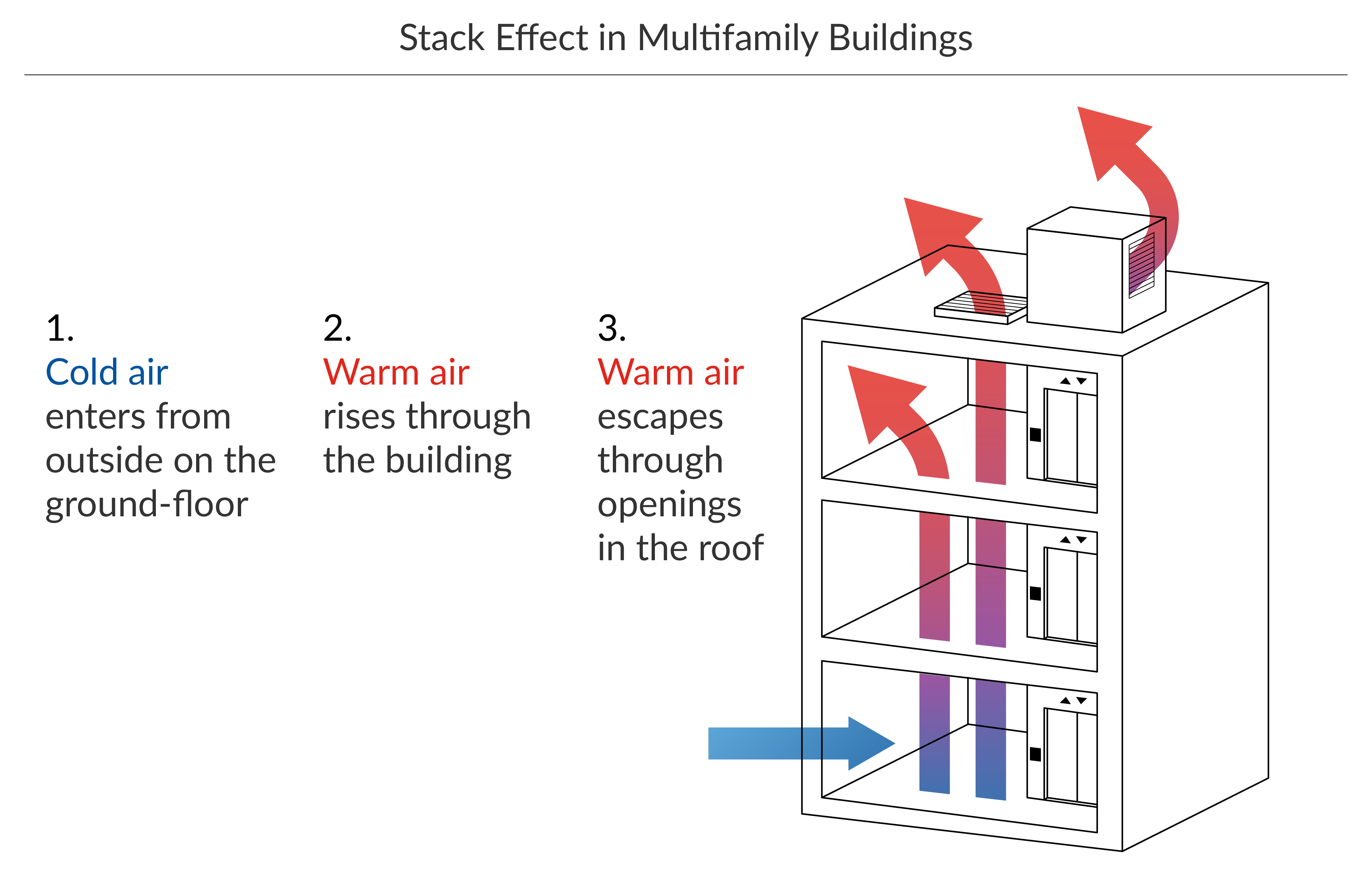
“If the building is tall, uncontrolled stack effect causes top units to see no fresh air, while bottom units see large volumes of fresh air infiltration.”
— Erdem Kokgil, Passive House Solutions Manager, Oxygen8
The building may not behave the same way on every floor. Plan for that and check airflow by floor during Testing, Adjusting, and Balancing (TAB) and commissioning.
Engineering note: If the design depends on corridor transfer, make sure it can handle wind and stack effect. Verify air delivery by floor, not just at the rooftop unit.
How Pressure Balance Helps Reduce Odor Complaints
Most odor problems aren’t solved by adding another fan. They’re solved by getting airflow back under control. Bring supply and exhaust into balance and confirm it stays there in all operating modes.
Balanced airflow helps keep the building neutral enough that air doesn’t constantly look for shortcuts.
“Pressure balance isn’t a one-time event; it’s a condition you design for and verify.”
— Erdem Kokgil, Passive House Solutions Manager, Oxygen8
After turnover, performance drifts when filters load, dampers stick, residents modify doors, or temporary adjustments become permanent. Airflow verification and commissioning support are important even when equipment is already installed.
Pressure balance is where many odor complaints are solved, but kitchens are often where the imbalance becomes visible.
Why Kitchen Exhaust Triggers Odor Complaints in Multifamily Buildings
In a multifamily building, kitchens break a lot of perfect ventilation diagrams.
When kitchen exhaust runs (or ramps up), whole-building pressure can shift quickly. That is often when complaints show up as corridor odors, drafts, or sudden spikes in odor transfer between units.
Certain exhaust streams should not be routed through recovery devices. Kitchen hood exhaust is a common example, because grease and pollutants can damage equipment and create indoor air quality concerns.
“For kitchen exhaust, we cannot bring greasy kitchen hood air back to these heat exchangers. You can increase the supply air temporarily, so that the building is still positively pressurized until that exhaust fan stops.”
— Erdem Kokgil, Passive House Solutions Manager, Oxygen8
Engineering note: Define the boost or temporary makeup sequence clearly: triggers, limits, duration, and how it’s verified during commissioning. Don’t assume it will be tuned later.
4 Multifamily Ventilation Approaches
Pressure relationships, exhaust performance, outdoor air delivery, and maintenance realities can all affect how systems perform.
Here we outline four common ventilation approaches in multifamily buildings.
Adding an ERV (energy recovery ventilator) brings in outdoor air and exhausts stale indoor air while transferring heat, and sometimes moisture, between the two air streams to reduce energy use.
For odor control, however, the key question is not just energy efficiency. It is whether any exhaust air can transfer into the supply airstream inside the ERV.
1. Centralized (No ERV)
This approach can work well when corridor pressurization and suite exhaust stay stable. Odor complaints usually begin when that pressure relationship reverses or the building allows air to bypass the intended path.
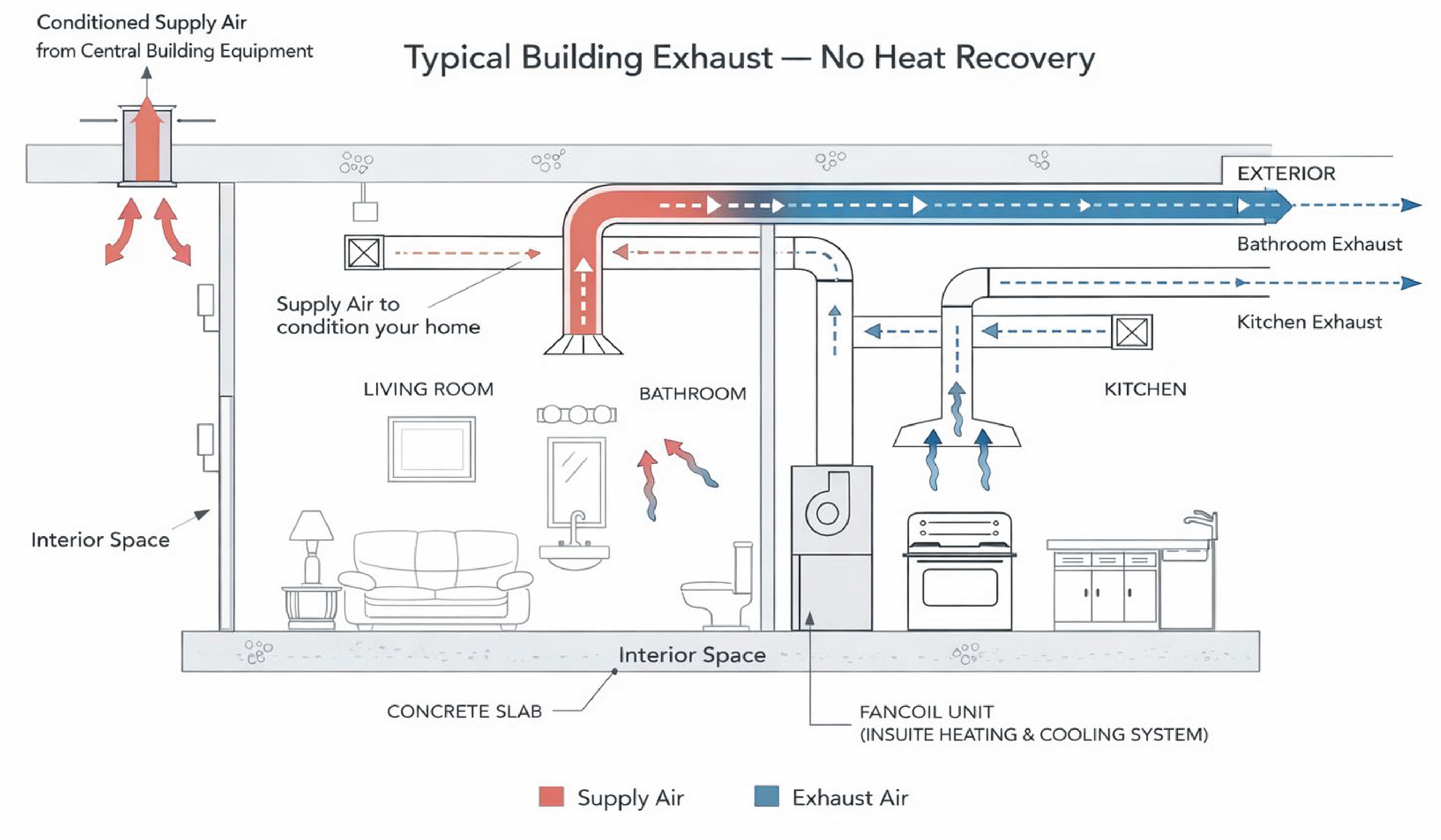
The intended airflow path is corridor to suite, then out through the exhaust. Source: Oxygen8
Pressure control only works if the building is reasonably tight. If air can move through gaps in walls, shafts, or door details, odors will move too.
Centralized (No ERV) is best for
Simpler systems where corridor pressure and suite exhaust stay consistent, and the building reliably holds its intended pressure relationships.
Common failure point
Pressure flips and weak exhaust. Odor complaints often start when corridor-to-suite airflow reverses, and stack effect can make performance vary by floor (especially in taller buildings).
What to verify
Airflow direction at suite doors (i.e. corridor to suite vs suite to corridor), confirm suite exhaust airflow is pulling, and verify performance by floor (not just one location), especially top and bottom floors in taller buildings.
Maintenance burden
Generally lower and more centralized than in-suite approaches (especially if outdoor air is handled by a rooftop make-up air unit), but the system can still drift after turnover when doors, exhaust, or field conditions change.
|
Advantages |
Disadvantages |
|
Lower first cost compared to ERV-based systems |
Higher operating cost (no energy recovery) |
|
Central filter access if outdoor air is handled by a rooftop make-up air unit |
Code constraints: may not meet current energy code requirements depending on jurisdiction / project type |
|
Simple concept (fewer recovery components) |
Stack effect risks in tall buildings: upper floors can get too little fresh air while lower floors see more infiltration |
From what we’re seeing in Mid-Atlantic multifamily projects, centralized approaches are still the most common, but interest in decentralized options is growing.
2. Centralized + ERV
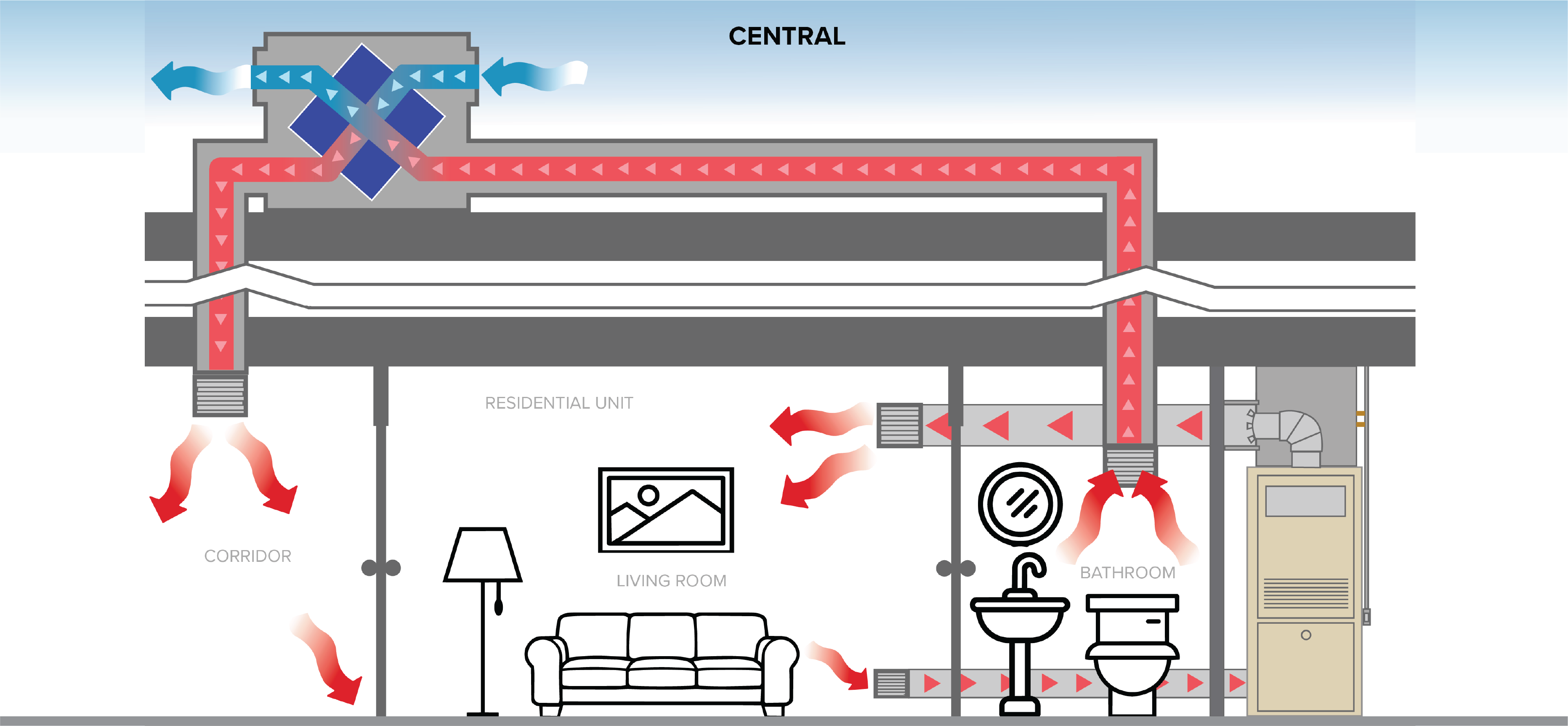
Centralized ERV systems can deliver outdoor air efficiently, but odor control still depends on stable balance, duct integrity, and pressure relationships. Source: Oxygen8
Centralized + ERV is best for
Projects that want consistent outdoor air with centralized maintenance access and have space for risers/shafts and central equipment.
Common failure point
Odor complaints can still happen if pressure relationships drift after move-in, especially when outside air/exhaust/relief balance is not maintained.
What to verify
Outside air/exhaust/relief balance during normal and boost modes and confirm kitchen hood exhaust is separate from recovery devices.
Maintenance burden
Lower unit-access burden than in-suite approaches because routine service is centralized, but performance depends on balancing, duct integrity, and controls staying stable.
|
Advantages |
Disadvantages |
|
Easier access for routine maintenance (filters and service are centralized) |
Requires vertical risers/shafts and (often) smoke control components |
|
Can upgrade filtration centrally when needed (e.g., smoke/wildfire events) |
More ductwork, higher cost and opportunities for leakage |
|
Consistent ventilation is achievable when airflow is properly balanced |
Space impacts for risers and rooftop/mechanical equipment |
|
Economies of scale with fewer large pieces of equipment |
Odor issues can still occur if pressure relationships drift after move-in |
We are seeing more interest in decentralized options, especially in buildings where suite-level control is a priority.
3. Decentralized In-Suite ERV
In-suite ERVs can reduce reliance on corridor airflow and give each apartment more direct ventilation control. They can perform well, but only when the suites are well compartmentalized and the maintenance plan is realistic.
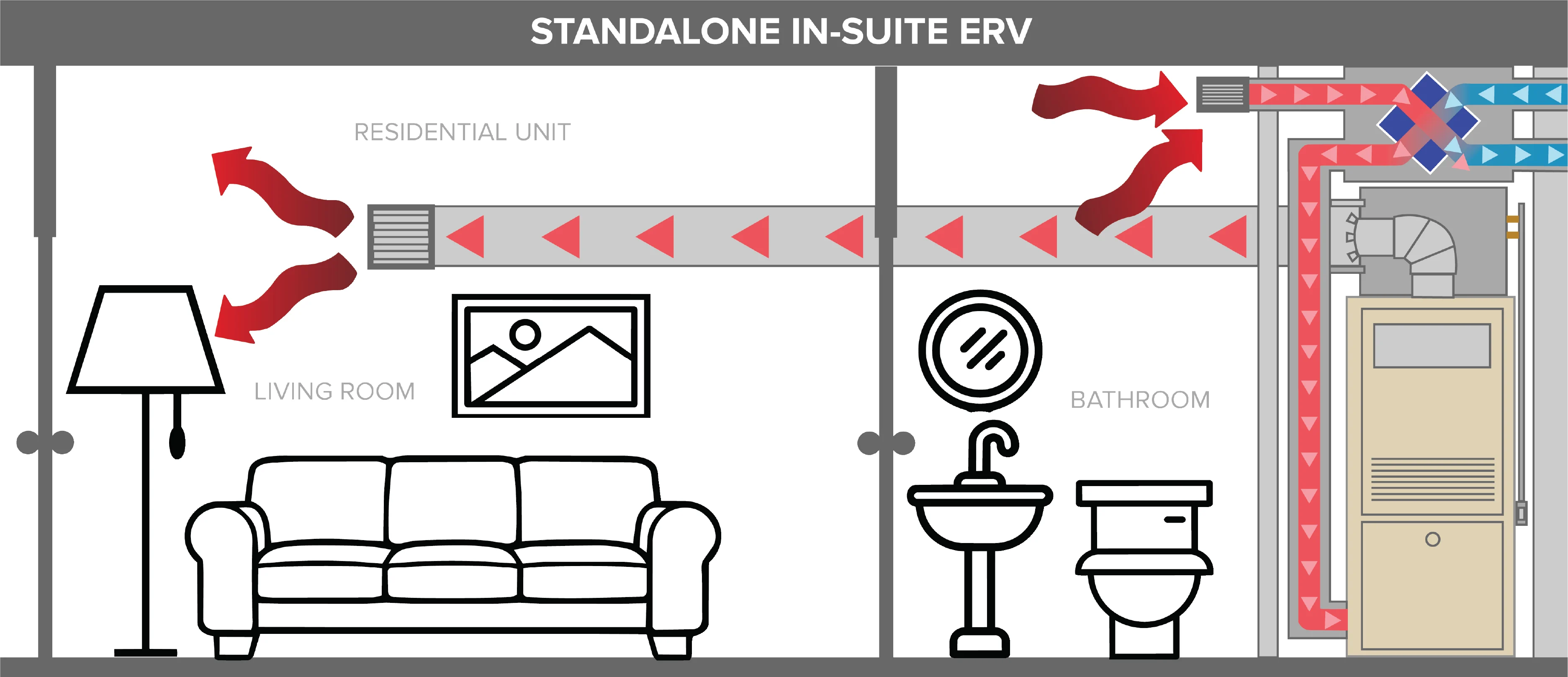
In-suite ventilation can perform well, but airflow rates drift when filter changes, service access, and unit-by-unit upkeep are inconsistent. Source: Oxygen8
Decentralized In-Suite ERV is best for
Buildings that want unit-by-unit ventilation control and reduced reliance on corridor airflow pathways, especially where the team values suite-level control, and the building is tight/compartmentalized.
Common failure point
Maintenance drift across units. Odor risk increases when filters are not changed consistently; airflow settings drift, or unit access is hard to maintain across dozens of apartments.
What to verify
Airflow in a sample of units (not just one), confirm compartmentalization assumptions, and confirm the filter/access plan is realistic: who owns filter changes, how unit entry is handled, and how changes are tracked.
Maintenance burden
High compared with centralized approaches because routine service often requires apartment entry, tenant coordination, and tracking performance across many in-unit devices.
|
Advantages |
Disadvantages |
|
More consistent air delivery per unit in tall buildings and windy sites |
Requires unit access for filter changes and service |
|
Balanced unit-by-unit ventilation can reduce suite-to-suite odor transfer |
Space impacts (bulkheads/closets) and more in-unit devices to maintain |
|
No large vertical risers and fewer shared-duct failure points |
More façade penetrations → higher air-sealing QA risk |
|
Per-suite boost control for bathrooms (when maintained) |
Cold-climate issues (long cold ducts, condensation/thermal bridging, defrost management) |
In many multifamily projects, especially new construction, first cost still drives early decisions. That is one reason centralized approaches remain common. Decentralized ERVs still make sense, but the decision should be based on a broader cost-benefit analysis.
Engineering note: Put the maintenance plan on the basis of design. List filter locations, access needs, and replacement intervals. If the design uses in-suite devices, define who is responsible (owner vs. resident), how unit entry is handled, and how filter changes are tracked.
4. Decentralized In-Suite ERV Integrated with Fan Coil
The same odor-control principles apply as decentralized in-suite ERVs. The main difference is operational: ventilation performance can be missed if service visits focus only on heating and cooling.
In-Suite integrated with fan coil is best for: Projects already using in-suite fan coils or heat pumps that want integrated ventilation and unit-level control
Common failure point: Ventilation airflow is not checked consistently during routine service
What to verify: Ventilation airflow (separate from heating/cooling), filter responsibility, and periodic spot checks
Maintenance burden: Unit access and tracking remain the key challenge
Note: The advantages and disadvantages are the same as in Decentralized In-suite ERV along with the following:
|
Advantages |
Disadvantages |
|
Many low cost and higher performance units are available |
When there is no heating/cooling demand, the air handling unit’s fan still runs to distribute air |
|
Balanced unit-by-unit ventilation can reduce suite-to-suite odor transfer |
Space impacts (bulkheads/closets) and more in-unit devices to maintain |
|
Low sheet metal costs as two systems are combined into one duct system |
|
|
Simple solution |
For a broader system-level view, see our multifamily HVAC system comparison of six electrified approaches based on total life-cycle cost.
Verification: Keep Odors from Turning into Costs
You don’t really know how a building will perform until you check it on site. Odor control as it relates to ventilation comes down to a few measurements: airflow, balance, and what happens when the system switches modes.
Use this checklist in design reviews and at turnover:
- Where is the air supposed to come from and where is it supposed to go? (corridor, suite, shafts, exhaust points)
- What will TAB and commissioning measure and record? (actual airflow numbers and pass/fail checks)
- Do we test more than one floor? In taller buildings, check at least the top and bottom floors, not just one “typical” spot.
- What happens when boost runs? Bath fans, kitchen fans, and any high-exhaust mode should not pull air the wrong way through the building. Confirm it returns to normal when boost ends.
- What is the filter and access plan after turnover? Who owns it, how do you get filters, and how often does it happen?
Ask for a short report with measured air flow values, which floors were checked, and results for normal and boost modes.
“Ventilation performance cannot be assumed; it must be measured. Verifying airflow and pressure relationships is especially critical in multifamily buildings, where controlling odor migration and maintaining proper pressurization are essential to delivering the level of comfort occupants expect.”
— Dave January, Sales & Operations Director, MSTB
Engineering note: Write balance requirements into the documents as measurable acceptance criteria (not just “TAB per spec”). Then test the system in the modes that trigger complaints; normal, boost, and any kitchen exhaust/makeup sequences.
Which Ventilation Approach Fits Your Building? Key Issues to Watch
The right approach depends on your building layout, maintenance model, and odor-control priorities. Each option has tradeoffs, so it helps to look at the common issues to watch for with each one.
- Centralized (No ERV): If pressure flips or exhaust is week, check door airflow direction and verify exhaust by floor.
- Centralized ERV: Watch for airflow imbalance. Verify outdoor air, exhaust, and relief airflow mode changes, and keep kitchen hood exhaust separate.
- In-Suite ERV: If maintenance gaps are a concern, spot-check unit airflow and confirm the filter replacement and service access plan.
- In-Suite ERV + Fan Coil: Check access and maintenance responsibility. Verify ventilation airflow and confirm who is responsible for filter changes.
Regardless of approach, confirm airflow and pressure when complaints occur.
Dealing with recurring odor complaints in a multifamily building?
Our team can help assess your ventilation strategy, pressure relationships, exhaust performance, and TAB and commissioning requirements for new and existing buildings.

Tim Dorman
Innovative Solutions Director, Havtech

Erdem Kokgil
Passive House Solutions Manager, Oxygen8