A Closer Look at Terminal Unit Performance
For decades, most single-duct VAV terminal units have placed the damper upstream of the reheat coil. While this configuration is familiar and still widely used, when applied to low-temp hydronic systems (120°F and below), it can introduce performance losses that aren’t always obvious at the design stage.
One recent innovation, the Price SDV-Vantage, takes a different approach by relocating the damper downstream of the coil to improve efficiency and airflow performance.


Damper Position vs. Coil Performance
Recent third-party studies and testing show that placing the damper upstream of the coil can lead to:
- Uneven airflow across the coil face at part-load
- Up to 13% loss in heating capacity, even at steady airflow
- Temperature stratification in the discharge duct
- Reduced accuracy of zone control and sensor feedback
These issues are especially problematic when working with condensing boilers or heat pump systems, where water temperatures are lower and thermal performance margins are tighter.
Downstream Damper Placement Option
Moving the damper downstream of the coil helps maintain uniform airflow across the heat exchanger. Testing has shown this approach can lead to:
- Improved heat transfer across all damper positions
- Reduced fluid flow requirements, lowering pump energy use
- More consistent discharge air temperatures
- Fewer issues with sensor control logic due to stratified temperatures
This configuration addresses a common but often-overlooked efficiency gap in low-temp reheat design.
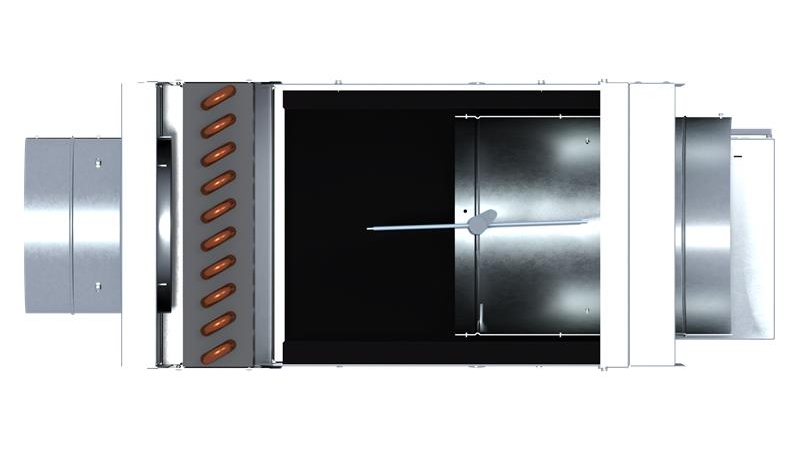
Price Industries Vantage cross section showing the downstream damper.
Is this relevant to your next project?
If you’re designing HVAC systems for schools, offices, or healthcare facilities, here are a few questions to consider:
- Are you specifying VAV terminal units to perform using 100–120°F hot water supply conditions?
- Do your system sequences depend on accurate downstream temperature sensing or stable airflow control?
- Is your team trying to reduce pumping energy, system air pressure drops, or improve boiler return temps?
If so, damper placement should be evaluated just like any other critical component.
It’s not a replacement, It’s a design option
Upstream damper configurations still have their place. They’re well-understood, reliable, and appropriate for many conventional hydronic designs.
This isn’t about replacing one standard with another: it’s about aligning the terminal unit design with the performance goals of today’s low-energy systems.