Not every classroom complaint is an Indoor Air Quality (IAQ) problem.
A classroom that meets ventilation requirements can still be uncomfortable.
It may feel humid after a rainy morning, drafty near one row of desks, too warm in the afternoon, too cold near the windows, noisy when the unit ramps up, or uncomfortable even when the thermostat looks normal.
Before a school district spends money on increased airflow, new equipment, or changes to controls, the key is to understand what is causing the real issue.
Indoor Air Quality (IAQ) focuses on ventilation, filtration, outdoor air, and airborne contaminants. Those are important, but they do not explain every comfort, noise, humidity, or distraction complaint inside a school building.
Indoor Environmental Quality (IEQ) encompasses a broader set of conditions that shape the learning environment: air quality, temperature, humidity, acoustics, lighting, visual comfort, controls, maintenance, and building conditions.
This article focuses on HVAC-related IEQ factors vs. lighting and visual comfort which are part of broader school facility planning.
Before School Districts Invest, Ask Better Questions
Smart IEQ decisions start with treating complaints as clues rather than conclusions.
A daily reality for school facility teams is a high volume of comfort and IAQ complaints.
They may be responding to complaints from one classroom while the room next door seems fine or hearing different feedback from teachers in the same conditions. A work order may say “IAQ issue,” but the cause could be a schedule setting, a sensor location, a damper position, a humidity load, an old repair, or a system that no longer matches how the space is used.
Before investing in new equipment, airflow changes, or controls, ask:
- What type of conditions are people experiencing?
- When and where does the problem happen?
- Is it tied to weather, occupancy, schedules, controls, or a specific system?
- Are complaints isolated to one room, one wing, or one building type?
Check the space and determine whether the issue ties to air quality, humidity, temperature, acoustics, controls, maintenance, or building conditions.
Prefer to listen?
Tim Dorman explains how IAQ, comfort, humidity, acoustics, and HVAC decisions work together in school buildings. Watch the school IEQ webinar
Start by Evaluating School IEQ as a Whole
Classroom complaints rarely happen in isolation.
A stuffy room may point to ventilation, humidity, air distribution, controls, maintenance, equipment operation, or building envelope conditions.
School buildings rarely operate exactly as they were designed on paper. Spaces get repurposed. Schedules change. Repairs are made over time. Renovations are not fully documented. Testing, adjusting, and balancing may be incomplete. Maintenance access may be difficult. A system designed for one occupancy pattern may now be serving a very different school day.
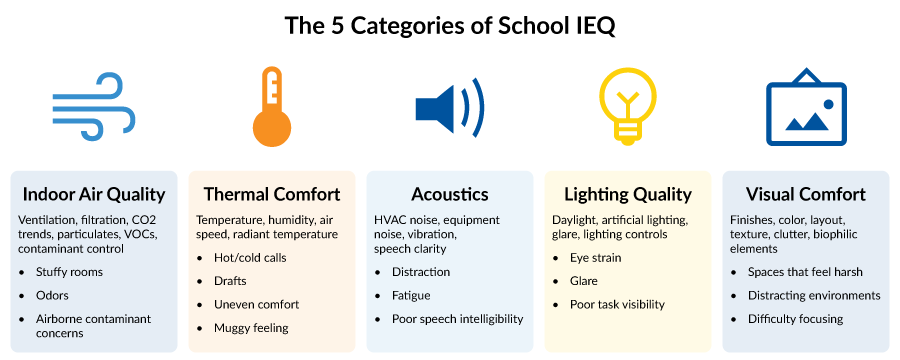
Consider school IEQ across five major categories.
Building Conditions Affect More Than Comfort
Schools are complex buildings with high occupancy, long operating hours, aging systems, and limited budgets.
“By the time a student graduates from high school, students may have spent 15,600 hours inside a school.”
Harvard T.H. Chan School of Public Health, Healthy Buildings Program, Schools for Health: Foundations for Student Success.
The EPA links school building conditions, including HVAC problems, moisture, cleaning practices, and maintenance issues, with student health, absenteeism, and academic performance.
EPA guidance notes that schools without major maintenance backlogs have shown higher average daily attendance and lower dropout rates.
- 4–5 more students per 1,000 in average daily attendance
- 10–13 fewer annual dropouts per 1,000
Those numbers connect directly to the work happening behind the scenes: keeping equipment running, managing moisture, responding to complaints, documenting conditions, and making the case for improvements that may not be visible until something goes wrong.
Better IEQ planning helps connect complaints to the right room and system conditions.
IAQ Gets Attention, But Outdoor Air is Not the Only Tool
IAQ gets the most attention because it is tied to ventilation rates, filtration, code requirements, and airborne contaminants.
Most school HVAC systems are designed using the Ventilation Rate Procedure (VRP). VRP uses occupancy and floor area to determine how much outdoor air is brought into the building.
Outdoor air is costly because it must be heated, cooled, dehumidified, filtered, and moved.
When outdoor air requirements increase, schools may need to account for larger equipment, energy recovery, electrical requirements, structural considerations, and operating costs.
That is where the Indoor Air Quality Procedure (IAQP) becomes important. IAQP focuses on controlling contaminants rather than relying only on outdoor air volume. It allows the design team to consider a combination of outdoor air, recirculated cleaned air, filtration, air cleaning, and monitoring.
Before increasing airflow or adding equipment, it is important to understand what contaminants or comfort conditions need to be addressed and which approach makes the most sense for the building.
Resource:
For more details on how VRP and IAQP affect school HVAC system sizing, first cost, and long-term operation, read: School IAQ and HVAC Costs: What Facility Leaders Should Know Before Increasing Outdoor Air. Find out what to check
CO₂ Does Not Tell the Whole IAQ Story
School districts track CO₂ because it indicates occupancy patterns and ventilation demand. But CO₂ is one data point. It should prompt an investigation, not serve as the only measure of IAQ.
What CO₂ Can and Cannot Tell You
|
CO₂ Helps Show |
CO₂ Does Not Show |
|
Occupancy patterns |
Particulates |
|
Ventilation demand |
Volatile Organic Compounds (VOCs) |
|
Whether ventilation may be keeping up with people in the room |
Formaldehyde |
|
Trends during the school day |
Filtration performance |
|
When further investigation is needed |
Moisture or microbial risk |
|
Important note on CO₂ ASHRAE does not treat CO₂ as a stand-alone measure of acceptable IAQ. CO₂ is better understood as an indicator of occupancy and ventilation demand, not as proof that indoor air quality is good or bad. |
Humidity and Comfort Are Part of the Same Conversation
Humidity is easy to underestimate because a classroom can feel uncomfortable even when the temperature looks right.
EPA school guidance recommends maintaining indoor relative humidity below 60 percent, and ideally between 30 percent and 50 percent to help protect health and comfort.
When the air is too dry, respiratory concerns become harder to manage. When the air is too humid, schools may see odors, condensation, mold growth, material damage, and microbial risk.
Start by identifying where the humidity problem is coming from: outdoor air, equipment operation, controls, envelope conditions, schedules, or a combination of factors.
Thermal comfort is more than a thermostat reading
Thermal comfort is personal. Two people can sit in the same space and experience it differently. Comfort depends on air temperature, humidity, air speed, radiant temperature, activity level, and clothing.
A student near a window may feel radiant heat or cold. A teacher under a diffuser may feel a draft. A humid classroom may feel warm even when the thermostat says the room is at setpoint.
This is why comfort complaints should not be judged by the thermostat alone. The better question is what conditions are shaping the experience in that space and whether those conditions can be measured, adjusted, or improved.
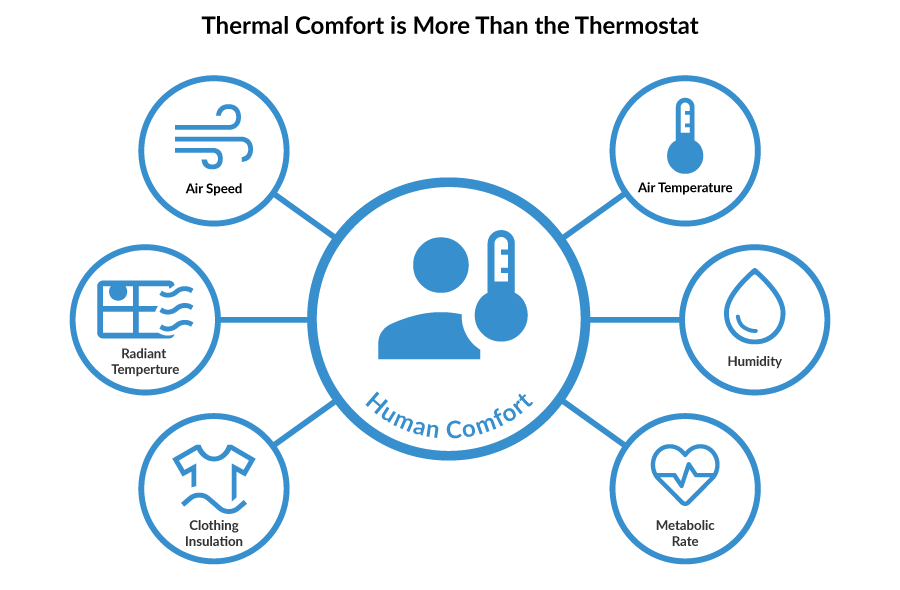
ASHRAE Standard 55 identifies six primary factors that affect thermal comfort: metabolic rate, clothing insulation, air temperature, radiant temperature, air speed, and humidity.
Acoustics Are Part of the Learning Environment
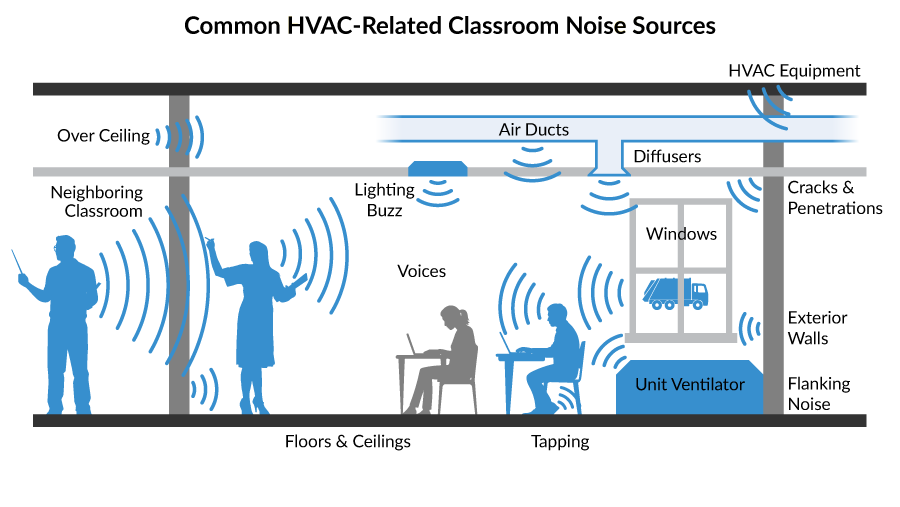
Background noise interferes with listening, especially when students are trying to hear instructions or speech from across the room. For classrooms, ANSI/ASA S12.60 sets acoustic performance criteria for reducing background noise and helping students hear and understand speech clearly.
Acoustic complaints may come from:
- Rooftop units
- Fan-powered terminal units
- High duct velocities
- Diffuser noise
- Vibration through the structure
- Outdoor equipment
- Transfer openings
- Fans ramping too aggressively during occupied hours
Sound issues are difficult to diagnose because the source may not be where the complaint is heard.
Many HVAC noise problems can be reduced without major renovations. Common solutions include silencers, duct insulation, acoustic louvers, silencing transfer grilles, equipment sound enclosures, vibration isolation, and control adjustments.
IEQ Decisions Have to Fit the Budget
In most cases, the facility team knows a building needs upgrades. But the budget may also support safety, curriculum, staffing, transportation, technology, and other district needs. Identifying a problem is one thing. Funding the fix is another.
When complaints are backed by building data, facility teams can connect occupant feedback to building performance. That evidence helps facility teams prioritize projects, phase improvements, and pursue funding opportunities that match the issue.
Complaint to Cause: What to Check First
A complaint is reported. The next step is to narrow the possible cause.
|
Complaint |
Start by checking |
|
“The room feels stale by mid-morning.” |
CO₂ trends, outdoor air damper position, occupancy schedules, filtration, supply airflow |
|
“The room feels damp, sticky, or smells musty.” |
Relative humidity, coil performance, outdoor air load, controls, envelope conditions |
|
“This room is always too hot” or “students are wearing coats inside.” |
Space temperature, supply air temperature, air distribution, sensor location, schedules |
|
“Air is blowing directly on students or staff.” |
Diffuser placement, air speed, supply temperature, room layout |
|
“The unit is too loud when the teacher is talking”
|
Equipment location, duct velocities, diffuser noise, vibration, fan operation |
|
“We keep getting calls from the same room, hallway, or wing.” |
Controls, zoning, envelope, maintenance history, equipment condition |
The goal is not to diagnose every problem from a complaint alone. The goal is to narrow the issue before deciding whether the response is a control adjustment, maintenance correction, targeted repair, or larger upgrade.
Key Takeaways
- IAQ is important, but only one part of school IEQ.
- Humidity, thermal comfort, acoustics, controls, maintenance, and the envelope conditions all affect the learning environment.
- Better IEQ decisions start with symptoms, room and system checks, likely causes, and verification.
Need help understanding what is driving classroom complaints?
For Mid-Atlantic schools, humidity, aging equipment, and changing occupancy patterns can make IEQ planning especially important. If your school is dealing with recurring complaints, Havtech can help evaluate the conditions behind the issue and identify the right next step.
About the Author
Tim Dorman is the Innovative Solutions Director at Havtech. He brings deep expertise in Indoor Environmental Quality and HVAC system design, helping clients implement smarter, more efficient mechanical solutions. Known for his collaborative approach and technical insight, Tim is a trusted advisor across the building industry.

Tim Dorman
Innovative Solutions Director
Havtech