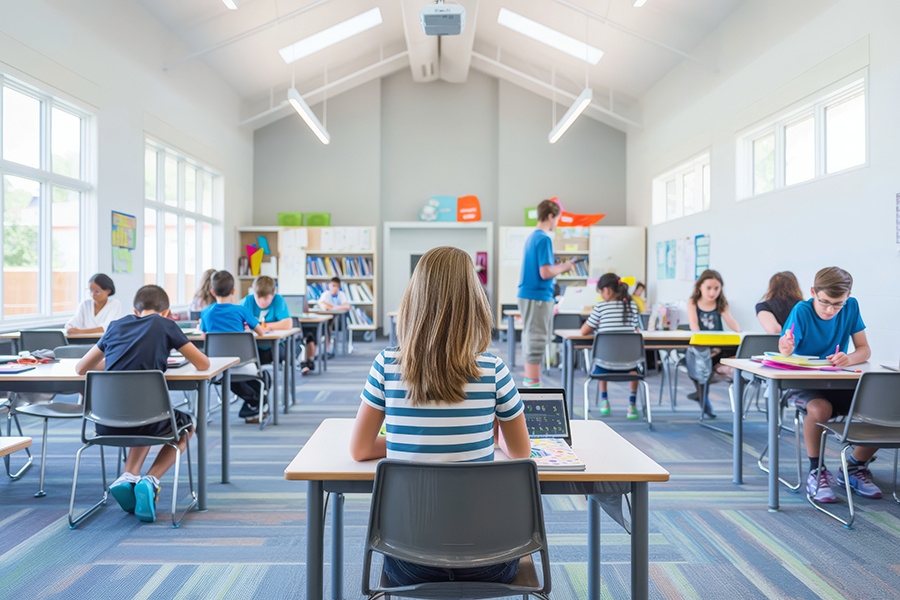
Most school districts assume their HVAC systems deliver acceptable indoor air quality (IAQ). Across the full portfolio, that assumption may not be accurate.
Some buildings meet ventilation targets, while others fall short due to aging HVAC equipment, limited control visibility, or systems that have drifted from design intent. The challenge is knowing what to check first so districts can improve air quality without increasing operating costs or triggering a capital project.
This article draws from a recent session with Audwin Cash, CEO of GPS, on ASHRAE 62.1, ventilation, and acceptable indoor air quality.
With increasing expectations around indoor air quality in schools, many districts are evaluating how their buildings perform.
Why Managing Indoor Air Quality in Schools is Harder than it Looks
Managing indoor air quality in one building is manageable. Across 40, 60, or 70 schools, it becomes far more challenging.
In an energy study for a large K-12 school district, Spectrum Energy evaluated building performance, energy use, and indoor air quality across nearly 70 schools. The portfolio included a mix of HVAC systems and control capabilities. Some schools had newer equipment and better system visibility. Others were operating with older systems and limited feedback.
That variation raises the questions many districts are trying to answer:
- Can we improve classrooms without replacing major equipment?
- Can we fix complaints without increasing energy costs?
- Can this scale across the whole district?
If the answer is “no” to any of these questions, it’s difficult to justify moving forward.
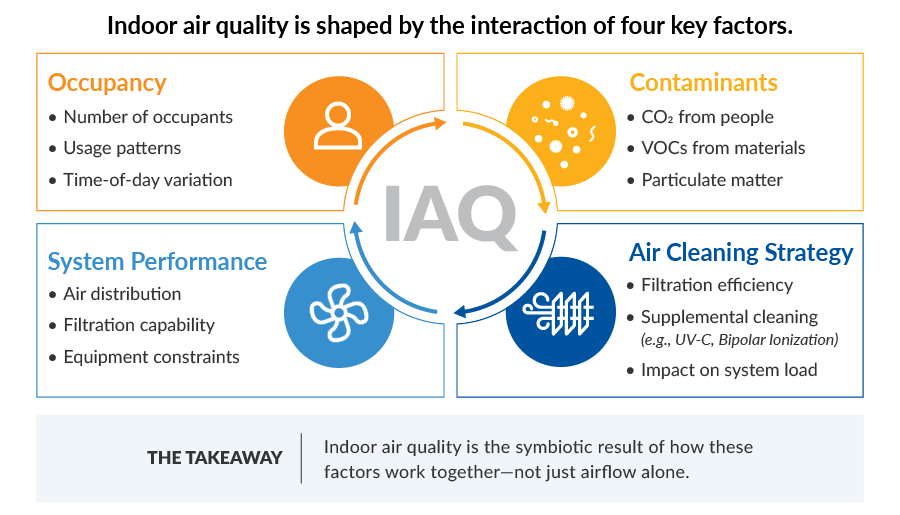
Instead of focusing on airflow, it helps to look at what is happening inside the classroom.
The Real Cost of Ventilation in School HVAC Systems
Most school HVAC systems are built around a simple assumption: bring in more outdoor air to dilute whatever is in the space. This works, but it’s expensive.
Every cubic foot of outdoor air has to be heated, cooled, moved, and controlled before it reaches the classroom.
The decision to bring in more outdoor air drives nearly every part of the system:
- Larger equipment to handle peak ventilation loads
- Higher cooling and heating demand
- More fan energy to move increased airflow
- Higher first cost and long-term utility bills
Outdoor air is expensive to condition — on the order of twenty times more energy than it takes to clean air.
Audwin Cash, CEO, GPS
How ventilation affects HVAC costs in schools
In large school districts, those costs escalate quickly.
In the Spectrum Energy study, energy costs increased between 65 and over 100 percent in roughly a decade.
Even small efficiency gains translate into meaningful dollars:
- A 2% reduction can save roughly $300,000 per year.
- A 10% reduction can approach $2 million annually.
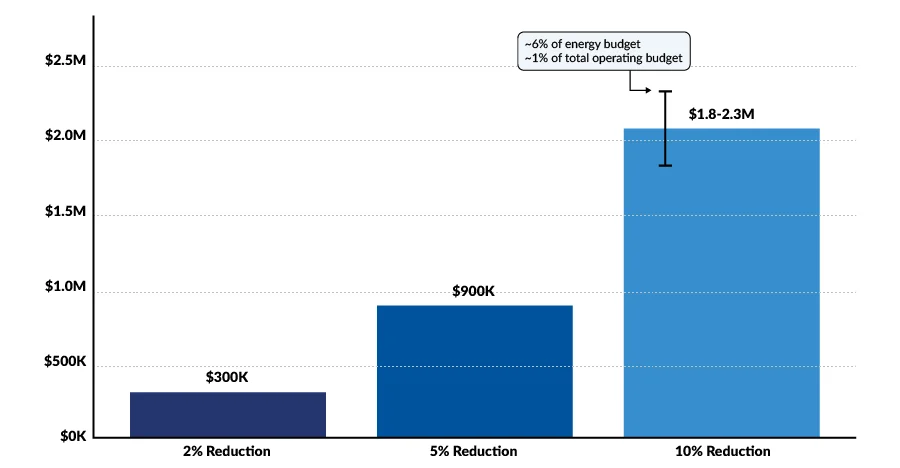
For districts that don’t have clear visibility into where energy is being used, school energy assessments can help identify performance gaps and prioritize improvements.
Those savings rarely stay in the energy budget. They usually go into staffing, programs, or deferred maintenance. Improving air quality is important, but it must work within budget constraints.
If more outdoor air increases cost and system load, the next question is whether there’s another way to maintain air quality.
That’s where the indoor air quality procedure (IAQP) comes in.
In many cases, that means rethinking how outdoor air is used rather than simply increasing it.
IAQP Explained: A Performance-Based Approach to School Ventilation
IAQP starts with a different question.
Instead of asking “How much air do we need?” it asks, “What’s actually in the air, and how do we control it?”
A traditional ventilation strategy (the ventilation rate procedure, or VRP) sets airflow based on people and square footage. It assumes that bringing in more outdoor air will dilute contaminants to acceptable levels.
IAQP looks at:
- Particulate matter (PM2.5)
- Gases like formaldehyde and other VOCs
- What occupants and materials are adding to the space
The goal is to keep contaminants below defined limits using a mix of outdoor air, filtration, and air cleaning.
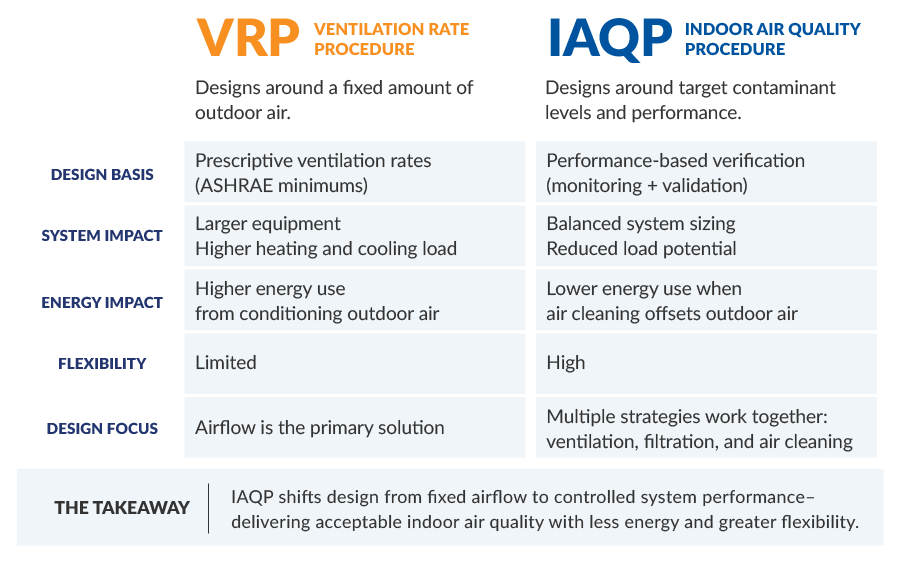
Instead of relying entirely on outdoor air, here is another strategy:
- Outdoor air for ventilation and pressurization
- Filtration for particulate removal air cleaning for gases and smaller contaminants
“The goal isn’t to remove outdoor air. It is to use it more intentionally.”
Audwin Cash, CEO, GPS
IAQP can reduce the amount of outdoor air the system has to condition. When that happens, cooling load, heating load, equipment size, and operating energy can come down with it.
From what we see across school projects, this often leads to:
- Reduced cooling and heating demand
- Fewer classroom temperature swings
- More consistent humidity control
- Better overall system stability
Want to see how IAQP is applied under ASHRAE 62.1?Audwin Cash explains how contaminant limits, ventilation rates, and air-cleaning effectiveness come together in this 1-hour webinar. PDH credits available. |
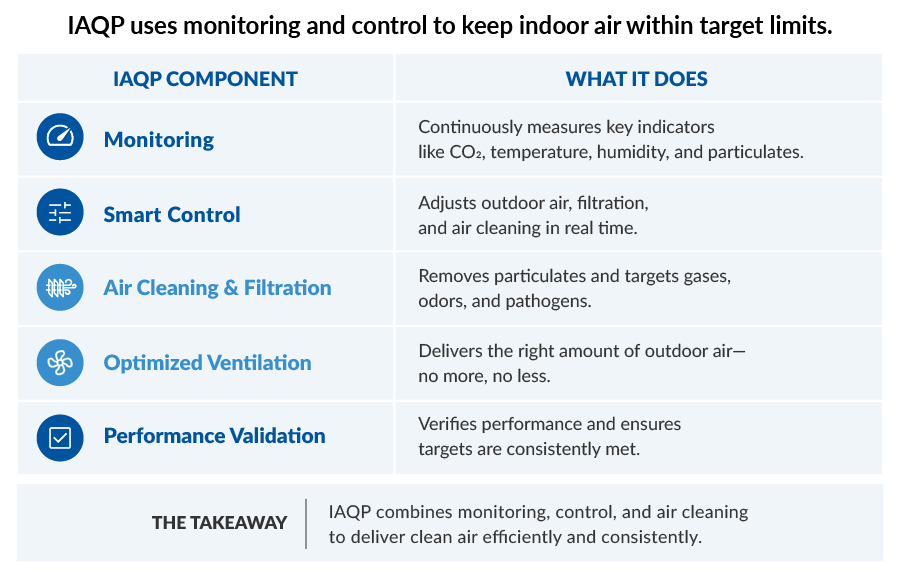
This case study “How K–12 School Saves with IAQP” provides additional context on how that shift is being applied in practice.
How Controls Make IAQP Work in Buildings
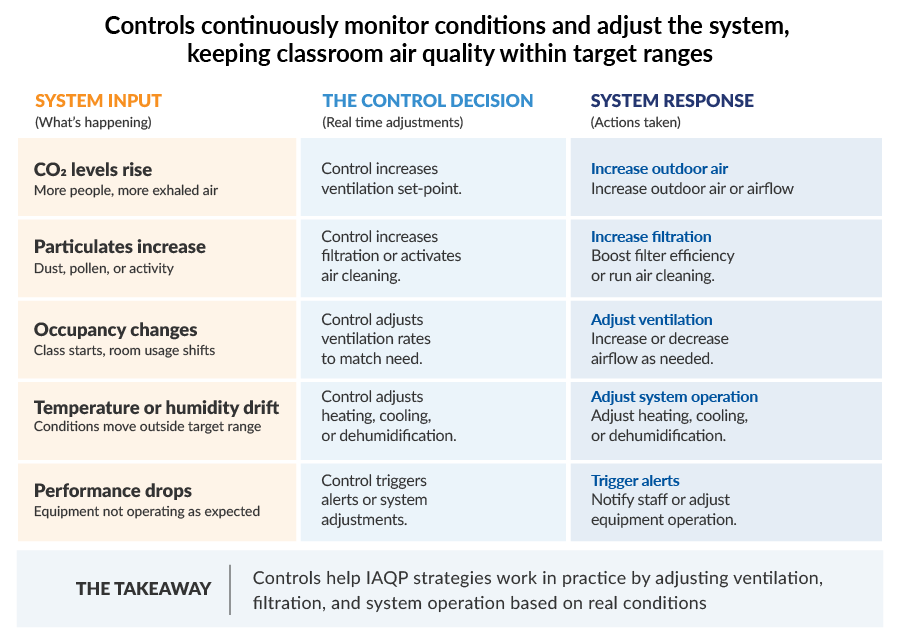
IAQP only works if the system can adjust to classroom conditions: occupancy changes, CO₂ levels, temperature, and humidity.
That is where the control sequence matters. Outdoor air dampers, sensors, air handlers, and terminal units all need to work together to allow the system to adjust ventilation and maintain comfort without over-conditioning the space.
That can include:
- Adjusting outdoor air based on CO₂ levels
- Maintaining temperature and humidity within target ranges
- Responding to changes in occupancy throughout the day
Without that feedback, the system operates on assumptions. With building automation and controls, the system maintains conditions more consistently while avoiding unnecessary load.
How to Improve Indoor Air Quality in Schools Without Increasing Costs
In a classroom, the goal is to keep the space comfortable while managing the contaminants that build up during the day.
That comes down to three things:
- How much outdoor air does the system need?
- How well is the air being cleaned?
- Can the controls respond to changing conditions?
When those pieces are aligned, the system has a better chance of improving air quality without adding load it can’t handle.
Using filtration and air cleaning more effectively
Filtration and air cleaning are the tools that help reduce contaminants without relying only on outdoor air.
Options include:
- Higher-efficiency particulate filters
- Gas-phase filtration for VOCs and formaldehyde
- Supplemental air cleaning in high-density spaces, like classrooms, cafeterias, media centers, or nurses’ offices.
The goal is to remove contaminants affecting air quality without pushing the system past its limits.
In classrooms, that can show fewer temperature swings, better humidity control, and more consistent conditions during occupied hours.
| Air cleaning is one part of a successful IAQP strategy, especially when outdoor air is being reduced. For more insight read this short guide to Air Cleaning Technology for Schools and IAQP compliance. |
Where IAQP Works Well in School Buildings
In K–12 buildings, IAQP is especially useful when a school needs better air quality, but the HVAC system can’t support more outdoor air. That’s common in older buildings where equipment still has useful life, but the system is already near its limits.
We tend to see the strongest fit when:
- The building can’t support more outdoor air without major upgrades
- The district needs to improve classroom conditions without replacing entire systems
- The project is part of a phased, portfolio-wide plan
- The team has access to controls, trend data, or post-occupancy verification
That is how Spectrum Energy approached their K-12 school district study. They started with data, identified performance gaps, and prioritized the buildings where improvements had the greatest impact.
When to be cautious with IAQP in schools
IAQP is not the best fit for every space. When spaces have high exhaust and low occupancy, the IAQP method may not make financial sense from an energy saving standpoint. While savings can be observed in many cases and building applications, outdoor air will always be required for building pressurization purposes.
So if a space has a significant amount of exhaust air and not many occupants, there is a limited opportunity to clean recirculated air for the purpose of ventilation and cost savings. In these spaces, using the ventilation rate procedure is still probably best.
Important considerations:
- Do not reduce outdoor air without confirming contaminant control.
- Do not rely on an air-cleaning device unless verified through testing, not marketing claims.
Why Data Matters in School HVAC and IAQ Performance
Many districts don’t have a clear view of how their systems are performing. That makes it difficult to validate whether an IAQ strategy is working or where adjustments are needed.
For the K-12 school district study, a large part of the effort focused on building a consistent data foundation across the portfolio:
- Energy use intensity (EUI) to compare buildings of different sizes
- Cost per square foot to understand budget impact
- Total energy spend to track overall financial performance
- Basic IAQ indicators, such as CO₂, temperature, and humidity, to understand how spaces are performing for occupants
With those metrics in place, the study compared buildings, identified underperforming sites, and prioritized where improvements would have the most impact.
In some cases, this level of visibility is no longer optional. Requirements like Virginia’s indoor air quality law are pushing districts to document how systems perform and maintain acceptable conditions.
Common data gaps in school districts
Even when systems are in place, the data is often incomplete or inconsistent.
What we often find:
- Inconsistent building data
- Missing history
- No clean way to compare one school to another
Indoor air quality decisions don’t stay within the HVAC system. They show up in comfort, complaints, and energy use. That’s why IAQ, energy, and capital planning are tied together.
How to Evaluate School IAQ Strategies for HVAC Retrofits and Upgrades
Before committing to an equipment or controls retrofit, upgrade, or new design, start by verifying how the system performs today.
Ask:
- Is the system bringing in the outdoor air it was designed to provide, or has that changed over time?
- Are filters installed correctly and performing at their rated efficiency?
- Are classrooms receiving consistent airflow throughout occupied hours?
- Are CO₂, temperature, and humidity staying within expected ranges?
- Do you have reliable trend data, or are decisions based on assumptions?
- Is there a plan to verify performance after changes are made?
The goal is simple: confirm what the system is doing now before spending money, reducing outdoor air, or adding new air-cleaning technology.
This is where coordination and follow-through matter most. System selection, controls, and verification all need to be aligned. If one piece is missing, the overall approach starts to break down.
Key Takeaways
- IAQ decisions in schools are tied directly to cost, not just comfort
- More outdoor air increases system load and is not always the most effective solution
- IAQP shifts the focus from airflow to controlling contaminants in the space
- System performance depends on how controls, filtration, and ventilation work together
- Verifying performance after occupancy is just as important as the design itself
- Small efficiency gains scale quickly across large school districts
If you don’t have a clear view of how your buildings are performing today, that is the first problem to solve.
Havtech works with school districts to assess indoor air quality, system performance, and energy impact across building portfolios.
This includes identifying where systems are falling short, prioritizing improvements, and supporting documentation for IAQ requirements.
About the author
Tim Dorman is the Innovative Solutions Director at Havtech. He brings deep expertise in Indoor Environmental Quality and HVAC system design, helping clients implement smarter, more efficient mechanical solutions. Known for his collaborative approach and technical insight, Tim is a trusted advisor across the building industry.

Tim Dorman
Innovative Solutions Director
Havtech
Technical Contributor
Audwin Cash is the CEO of GPS Air. Audwin joined GPS Air after roles as President of Climate Systems at Regal Rexnord, and SVP of Digital Controls at Acuity Brands Lighting. In these roles, Audwin was a business leader focused on marrying energy efficient solutions to a real return on investment for clients. He holds a BS in Computer Engineering from Georgia Tech and an MBA from Lehigh University.

Audwin Cash
CEO
GPS Air