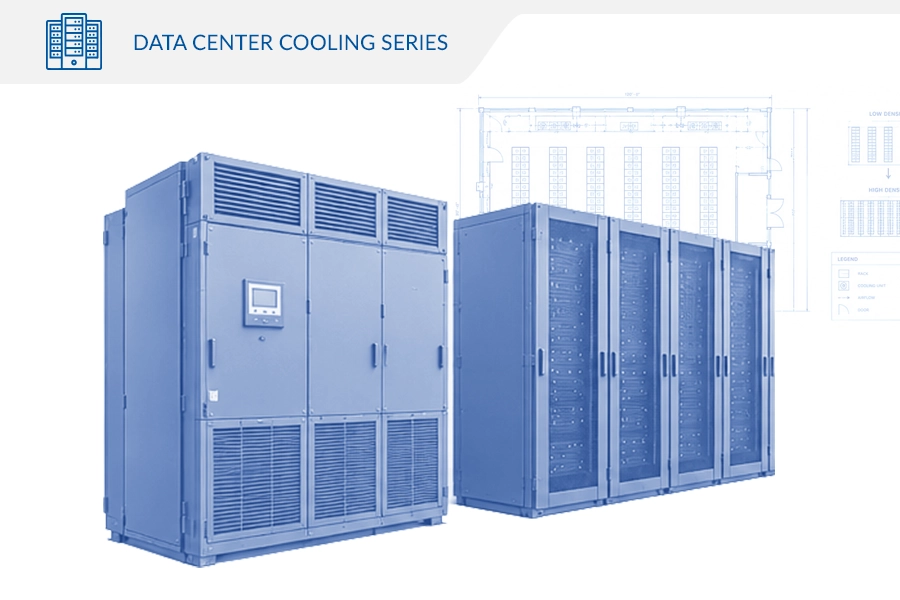
Data centers are no longer just facilities for storing everyday internet services. They now house the powerful servers that serve as the workhorses of artificial intelligence, dramatically increasing the energy output and heat these facilities have to manage. While data center environments used to range between 5 and 10 kilowatts per rack, the demands of AI workloads have pushed densities to 30, 50, and in some cases over 100 kilowatts per rack. Going from 10 to 50 kW means planning for 5x the heat load in the same rack footprint.
Choosing cooling systems for data centers that support rising rack densities means planning for that escalation now rather than later.
How Rack Density Requirements Impact Data Center Cooling
Waiting to address rising rack densities can leave cooling capacity and distribution unable to meet equipment needs, increasing the risk of overheating and downtime. When cooling air can’t reach a denser rack or heated air circulates back toward the equipment, operating conditions get harder to maintain. Once rack density outpaces what the airflow design was built for, keeping equipment inlet temperatures within the intended range can be an uphill battle
Data Center Air Conditioning vs. Liquid Cooling
Your choice in a cooling system starts with your facility’s rack density and cooling requirements. Air cooling for traditional data centers uses CRAC or CRAH cooling units and hot aisle and cold aisle containment, which is a cost-effective option for lower-density facilities. As rack densities approach 30 to 40 kW, airflow becomes an important design check. Whether air cooling can support the load depends on the rack layout, containment, and how effectively air reaches the equipment and carries heat away.
If the existing air-cooling design can’t support those loads, liquid-assisted or liquid cooling may be an option. The right method depends on your facility’s rack density, IT equipment, and retrofit constraints. Rear-door heat exchangers capture heat from rack exhaust and can work with existing racks if they’re compatible and there’s room for piping and service access. Direct-to-chip cooling removes heat directly from processors through cold plates. Immersion cooling submerges compatible hardware in a dielectric fluid that transfers heat without conducting electricity.
Air and liquid cooling can also work together. A facility may add liquid cooling for higher-density racks while continuing to use air cooling for other equipment and remaining room loads.
What To Look for in Data Center Cooling Solutions
Your search for a data center cooling solution should start with the rack densities you need to support now and in the future. Then look at whether your existing airflow and cooling infrastructure can serve those loads. Once you know which approaches are feasible, compare them against the factors that will affect the final decision:
- Redundancy: N+1 or 2N configurations can help maintain cooling if equipment or supporting infrastructure fails.
- Local codes and compliance: Energy codes and building performance requirements vary by location, so check what applies to your facility when comparing system energy use and long-term operating costs.
- Ownership costs: Upfront price alone doesn’t tell the full story once energy use and maintenance are factored in over the system’s lifespan.
- Commissioning and TAB: Commissioning verifies equipment operation, controls, and system integration. Testing, adjusting, and balancing (TAB) verifies and adjusts air and water flows to meet design requirements.
Havtech works alongside data center teams to align these factors with rack density requirements and facility goals. Talk to an HVAC specialist to learn how to support your data center by building a system that can support you now and doesn’t become a liability later.