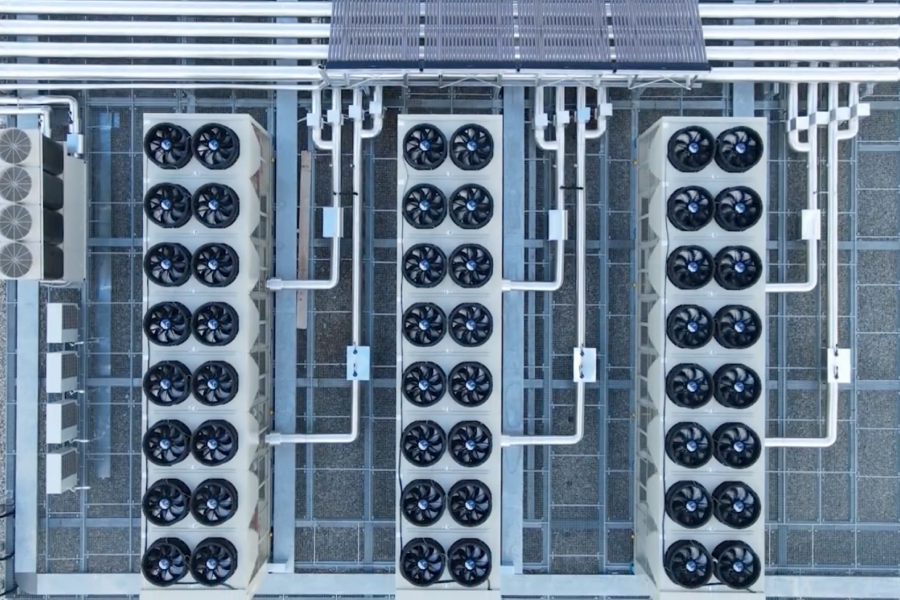
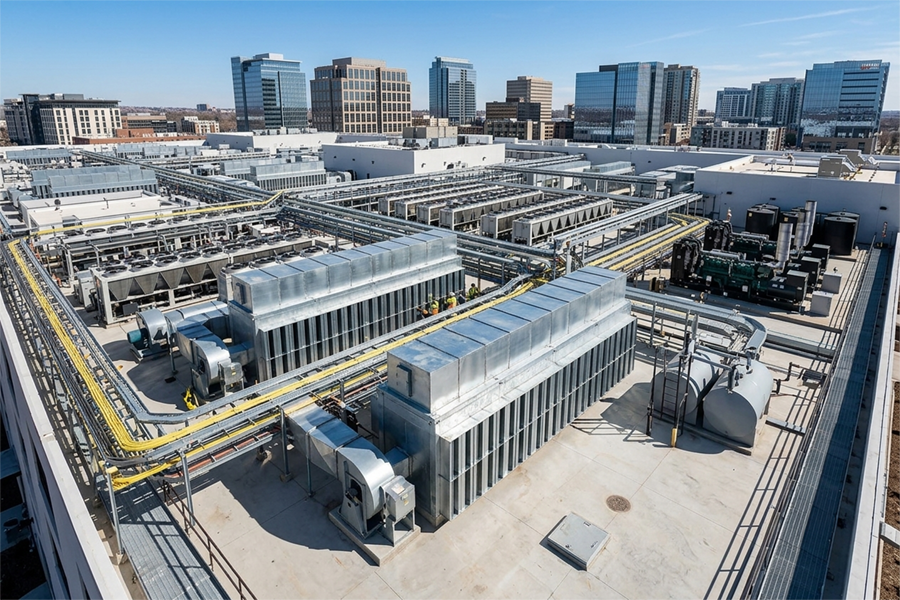
If your data hall has enough cooling capacity but still has a rack-level cooling problem, the issue may be where the heat is concentrated.
High-density GPU loads put more heat into individual cabinets, so adding more room cooling may do little to solve the thermal conditions at the rack. For engineers and facility teams, moving cooling closer to the IT load brings chilled-water distribution, redundancy, controls, power, and service access into the rack-level design.
During a recent Havtech session, Tim Boyd of DDC Solutions walked through what changes when cooling moves closer to high-density data center racks and what engineers should think about early in the design.
|
What Is Rack-Level Cooling? Rack-level cooling manages heat at an individual IT rack rather than relying primarily on room- or aisle-level air distribution. It can help address uneven rack densities by matching cooling more closely to the load at each cabinet. |
More Room Cooling May Not Solve a Rack-Level Heat Problem
Traditional data halls manage heat across a room or aisle. Cooling air must reach the servers, pick up heat, and return to the cooling equipment without mixing air where it shouldn’t.
With higher rack densities, pressure on that model because the loads aren’t necessarily uniform. One cabinet may require more cooling than the rack beside it. Boyd summed up what happens when room-level cooling is trying to manage those uneven loads:
“You are chasing heat around the room.”
– Tim Boyd, DDC Solutions
Rack-level containment takes a different approach. Rather than managing those differences across the room, the cooling system responds to the thermal load inside an individual cabinet.
Where Cooling is Managed

In one DDC rack-level example, air cooling capacity reached up to 100 kW per cabinet, with coolant distribution units (CDUs) available to support direct-to-chip liquid cooling at higher densities. These are manufacturer-stated capabilities; final selection depends on the IT load and equipment configuration.
Moving cooling closer to the rack may change the role of raised-floor air distribution, aisle containment, and other room-level cooling equipment. Define which cooling functions remain at the room level and which are handled at the rack.
| Prefer to hear the full technical discussion? Watch the on-demand session |
Define What Rack-Level Redundancy Needs to Cover
Some rack-level configurations include redundant cooling components.
For example, one fan can independently provide the required airflow if the other fan is unavailable. Redundancy also applies to the electrical side, with dual power feeds and A/B power distribution at the rack.
During design, define what needs to remain operational if a component or power feed is lost. Duplicate components alone don’t define the redundancy requirement.
|
System Area |
Redundant components |
Design question |
|
Cooling |
Dual fans, coils, and valves |
What cooling capacity remains if one component is unavailable? |
|
Water |
Two chilled-water supplies and return connections |
Are the connections served by independent water paths, and what happens if one is lost? |
|
Power |
Dual power feeds and A/B distribution |
What cooling functions remain available after loss of one feed? |
Plan for the Density You’ll Need Later
The rack load installed today may not be the load the facility needs later.
A phased rack-level approach lets capacity grow rack by rack or row by row as density increases.
“Plan for what they want to get to.”
– Tim Boyd, DDC Solutions
A phased approach is especially useful in retrofits, where the existing room may limit how much cooling infrastructure can be changed.
Chilled-water routing, power, and controls should account for the density the facility is expected to reach, even when the first phase is smaller.
A project may begin with air cooling and add a coolant distribution unit later to support direct-to-chip liquid cooling. Cabinet depth, service clearance, piping entry, and space for a future CDU should be checked before rows are fixed.
Plan Now for Higher Density Later

Before finalizing the rack layout, understand the expected end-state density, GPU platform, water availability, and whether a future CDU is likely.

DDC rack-level containment deployment examples. Image credit: DDC Solutions
Use the IT Load, Not Just the Room Temperature, to Control Rack Cooling
Because high-density IT loads can change quickly, room-level sensors may not capture what is happening inside individual high-density rack, even when they provide a good picture of conditions across the data hall.
DDC’s rack-level controls provide a more detailed view of conditions at the cabinet. Boyd demonstrated that operators can monitor rack temperatures along with valve position, water flow, entering and leaving water temperatures, dew point, humidity, and power. It can also provide equipment and maintenance alarms.
Changes in IT power can also give the cooling system an earlier signal. Rather than waiting for the resulting temperature change, DDC’s predictive cooling approach responds as GPU power rises.
Predictive Cooling
How rack cooling responds to a change in GPU power.

Decide what gets monitored at the rack, which alarms operators need to see, and what information needs to be shared with other systems.
Protection Moves Closer to the Rack
Rack-level containment also changes how the equipment is protected.
The DDC configurations discussed during the session use NEMA 3R-rated enclosures and integrated dry-chemical fire suppression. Rack-level fire suppression and enclosure protection help limit the impact of a localized event to the affected cabinet.
With liquid cooling, water connections move closer to the compute equipment, making it more important to contain a leak or other localized event at the rack.
Compare High-Density Rack Cooling Approaches
Rack-level cooling should not be compared with room- or aisle-level cooling based on equipment cost alone. The comparison should account for what equipment remains at the room level, what shifts to the rack, the space each approach requires, and how the design will support higher rack densities.
Rear-door heat exchangers are another way to move cooling closer to the load, but they typically remain part of a room-level cooling strategy. Rack-level containment manages the thermal environment within the individual enclosure.
Matching airflow and water flow more closely to the rack load may also reduce the need to overcool lower-density areas.
The same whole-system thinking applies to data center noise control, where acoustical treatment can affect airflow, pressure drop, and heat rejection.
|
Approach |
Where heat is managed |
Room cooling role |
Typical design context |
Key coordination |
|
Hot/cold aisle cooling |
Across room or contained aisle |
Primary cooling strategy |
More uniform rack loads where room airflow can reliably reach the IT equipment |
Air distribution, containment, return-air path, room cooling capacity |
|
Rear-door heat exchanger (RDHx) |
At the rack exhaust |
Part of the overall room cooling strategy |
When heat needs to be removed closer to individual racks without fully containing the rack environment |
Chilled-water piping to each rack, door clearance, and room airflow |
|
Rack-level containment |
Within the individual cabinet |
Room-level equipment may be reduced or reconfigured depending on the project |
Uneven or high rack loads where cooling needs to respond to the thermal conditions of individual cabinets |
Rack piping, redundant cooling components, A/B power, controls, service clearances and future CDU space |
The important question is where the cooling function needs to occur. As rack loads become less uniform, the design may shift more cooling responsibility from the room to individual racks. That changes not only cooling equipment selection, but also chilled-water distribution, power, controls, service access, and the amount of room-level infrastructure required.
5 Questions to Answer Before Finalizing the Data Hall Layout
- Confirm current and future kW per rack.
- Define the failure conditions the cooling system must tolerate.
- Coordinate chilled-water routing, power, and controls around the expected end-state density.
- Determine which rack-level signals need to be monitored or shared with other systems.
- Reserve the space and infrastructure needed for future cooling requirements.
Request a High-Density Rack Cooling Design Review
Review rack density, chilled-water availability, redundancy requirements, controls, and the path to future liquid cooling before the rack layout is finalized.
About the Author:
Tim Dorman is the Innovative Solutions Director at Havtech. He brings deep expertise in Indoor Environmental Quality and HVAC system design, helping clients implement smarter, more efficient mechanical solutions. Known for his collaborative approach and technical insight, Tim is a trusted advisor across the building industry.
 Tim Dorman
Innovative Solutions Director
Havtech
Technical Contributor:
Tim Boyd is a Senior Sales Executive for DDC Solutions, leading market growth and strategic customer engagement for high-density and advanced cooling solutions across the Eastern United States, Canada, and Mexico. A licensed Professional Engineer and frequent ASHRAE speaker with more than 28 years of HVAC industry experience, Tim brings expertise in engineering, field service operations, national account management, and executive sales leadership, with extensive experience supporting mission-critical facilities.
 Tim Boyd
Senior Sales Executive
DDC Solutions