The consequences of an incorrectly specified HVAC system in a school building are not always immediately apparent. They show up two years later when your energy bill shoots up, maintenance calls become more frequent, and you get complaints about classrooms with inconsistent ventilation. The pressure to make the right call the first time is real, and the consequences of getting it wrong can stick around long after the decision is made.
Understanding which HVAC system holds up best over time starts with understanding what makes school buildings different from every other commercial project.
What Makes HVAC Systems in Schools Different from Other Commercial Buildings?
Schools put demands on their HVAC systems that most commercial buildings don’t. There are air quality standards that need to be met, budgets for projects and maintenance that need to be managed, and classrooms that are constantly filling up and emptying out. A system that works well in an office building with less traffic may not be equipped to handle a school’s occupancy, operating hours, and varied spaces, from classrooms to gyms to cafeterias. HVAC systems used in schools have to account for all of those factors.
What Are the Most Common HVAC Systems and Equipment Used in Schools?
There is no single standard for HVAC systems or equipment used in schools. Long-term reliability depends on how well the system fits the building, operating schedule, ventilation requirements, and maintenance capabilities. The most common options include:
Packaged Rooftop Units (RTUS)
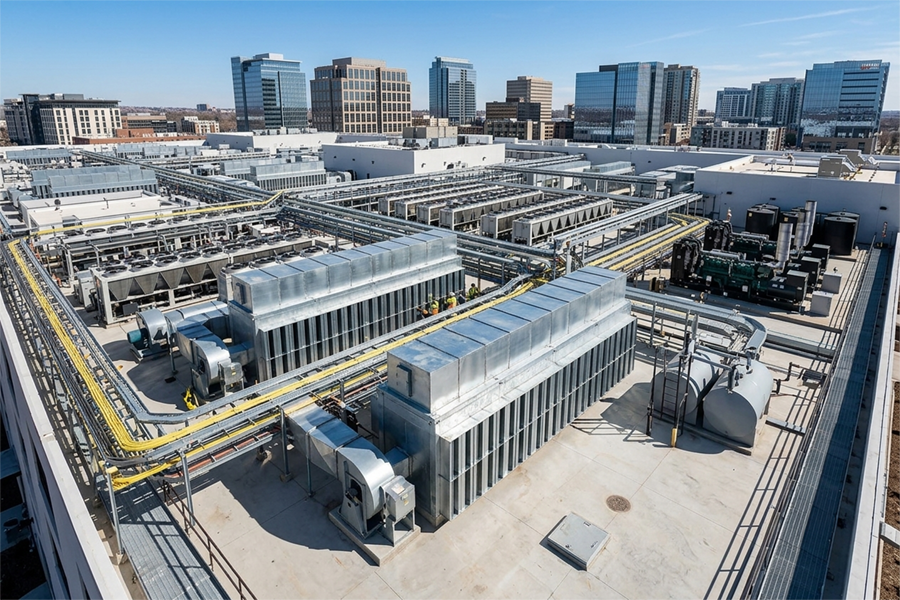
A practical and widely used choice for single-story schools, rooftop units are easy for many maintenance teams to access and can work well for phased replacements. Schools should still consider how well they support ventilation, energy use, and comfort across different spaces.
Compared with more centralized system, they can also make it easier to replace equipment serving one area without affecting the entire building.
Schools should still consider how well they support ventilation, energy use, zoning, controls, and comfort across different spaces. Because multiple units may serve a building, consistent maintenance across filters, coils, economizers, belts, fans, and controls is important.
Hydronic Heating and Cooling Systems
For larger, multistory schools, hydronic systems use heated or chilled water to serve air-handling units, unit ventilators, fan coils, or other terminal equipment.
These systems can provide flexibility across larger buildings, but they also rely on more interconnected components. To keep them working as intended, schools need a maintenance plan that looks at the full system, including pumps, valves, piping, controls, water temperatures, and terminal equipment, not just the boiler or chiller.
Variable Refrigerant Flow (VRF) Systems
For schools where classrooms, offices, and shared spaces run on different schedules, VRF systems provide flexible zone-by-zone heating and cooling and are typically paired with a separate ventilation system. Compared with more centralized systems, VRF often provides greater control at the room or zone level.
Keep your school’s needs in mind, that includes creating a maintenance plan that accounts for the full system, including indoor units, outdoor units, refrigerant piping, controls, and changing room use.
Central Air-Handling Systems
Central air-handling systems are commonly used to serve larger areas of a school and can support ventilation, filtration, heating, cooling, and air distribution from a central system.
Centralized equipment can simplify some maintenance activities because major components are located in fewer mechanical spaces. At the same time, performance depends on the entire air distribution system. Ductwork, dampers, controls, terminal equipment, airflow balance, and maintenance access all affect how well conditioned air reaches individual spaces.
Dedicated Outdoor Air Systems (DOAS)
Dedicated outdoor air systems manage ventilation separately from much of the building’s heating and cooling load and may be paired with VRF, fan coils, or other terminal systems.
Separating ventilation from space conditioning can give schools more control over outdoor air and humidity. The system still needs to be coordinated with the equipment serving individual spaces, particularly where classrooms, gyms, cafeterias, auditoriums, and offices have very different occupancy and ventilation requirements.
Unit Ventilators
Common in older school buildings, unit ventilators provide individual classroom control and ventilation. They can allow rooms to operate independently and may fit well in buildings designed around classroom-level equipment.
But because each room has its own unit, schools may have dozens or hundreds of individual pieces of equipment to maintain. Long-term reliability depends on consistent maintenance across filters, coils, dampers, valves, fans, and controls.
Which HVAC Systems for Schools Perform Reliably Over Time?
The answer to this question will be unique to your building. When is it occupied and for how long? How do spaces like classrooms, gyms, and cafeterias shift in and out of use throughout the day? Does your schedule change drastically throughout the school year?
Answering these more detailed questions will help you to find a system that is a match for your building. From there, two things determine whether the systems will hold up: whether it’s commissioned correctly at the start and how well it’s maintained.
How Do You Choose the Right Configuration for Your School?
The right configuration looks different for every school. Your decision will come down to:
- Building size, age, and layout
- Maintenance team capacity
- Capital and operating budget
- How the building is used
Documenting how your school operates before equipment selection leads to better decisions and fewer long-term operating issues. If you need help choosing the right HVAC system for your school, contact our experts.