“Can we use less water?”
It’s a reasonable place to start a data center heat rejection discussion. The answer depends first on the fluid temperature the cooling system needs to deliver.
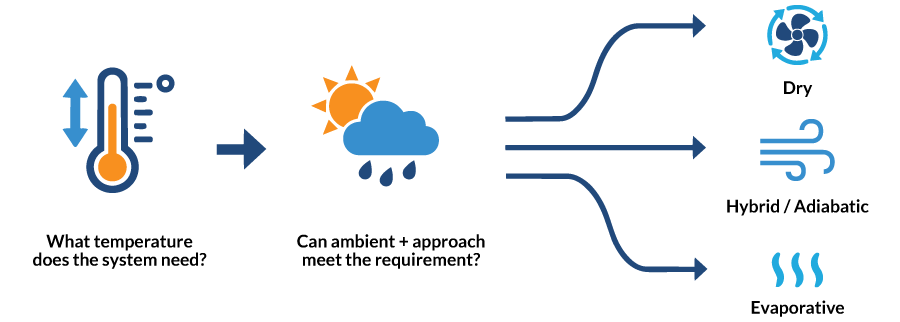
A dry cooler uses outdoor air, so its ability to meet that temperature changes with the site’s climate. Higher allowable fluid temperatures give the design team more options, including dry, adiabatic, and hybrid systems.
During a recent Havtech session, Dustin Cohick, Market Leader – Americas Data Center at BAC (Baltimore Aircoil Company, Inc.), explained how process temperature affects those choices and the trade-offs in water use, energy use, and space.
That relationship is becoming more important as higher-density computing pushes more cooling toward closed-loop liquid-based systems and changes the temperatures the facility loop may need to support.
Higher Rack Density Changes More Than the Data Hall
Rack density has climbed from the five-kW racks common in the late 1990s and early 2000s. Dustin described projects deploying 350- to 375-kW racks, with one-megawatt racks now being discussed.
That heat density is pushing cooling closer to the chip.
A traditional cooling path looks like this:
- Cooling tower or other heat rejection
- Chiller
- Computer-room air cooling
- Air-cooled rack
Direct liquid cooling changes the path. A coolant distribution unit (CDU) transfers heat from the liquid-cooled rack to the facility loop, bringing the cooling medium much closer to the heat source.
Traditional Chilled Water vs. Direct Liquid Cooling
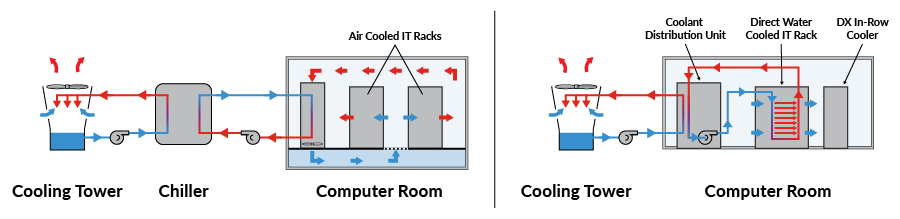 Source: U.S. Department of Energy, Federal Energy Management Program, “Cooling Water Efficiency Opportunities for Federal Data Centers.”
Note: The DOE diagram shows a conventional cooling tower. For direct liquid cooling applications, a closed-circuit cooling tower is recommended instead of open condenser water because most CDUs use small brazed-plate heat exchangers and require closed-loop cooling.
The temperature required by the facility loop also affects equipment outside the data hall. Some designs may need less chiller capacity, while higher-temperature applications may operate without a chiller.
A Dry Cooler Has a Temperature Limit
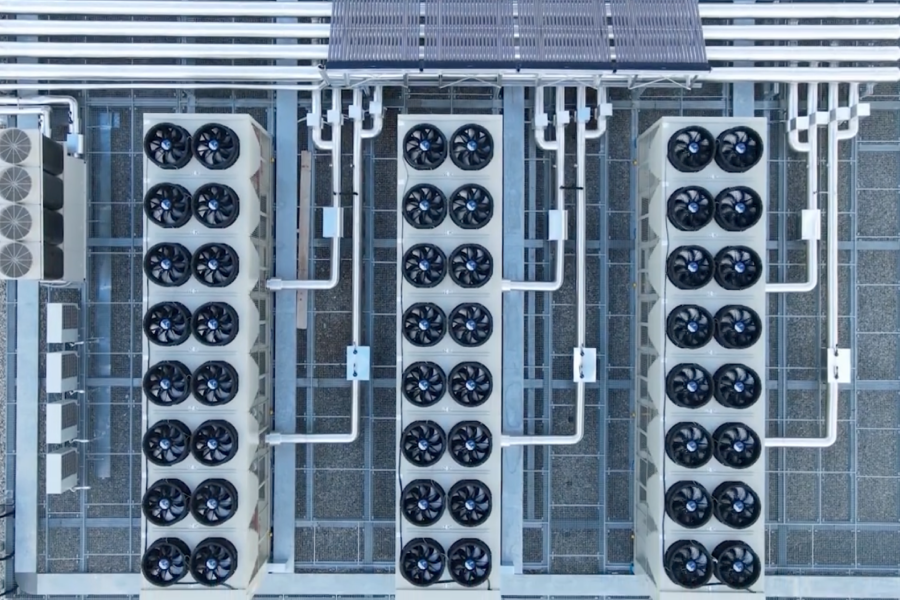
A dry cooler uses outdoor air to remove heat from the fluid in its coil. The fluid leaving the unit will be warmer than the outdoor dry-bulb temperature. The difference is called approach. For the applications Dustin discussed, a typical dry-cooler approach was around 10°F to 12°F.
That makes three numbers important when evaluating a dry cooler:
- Required leaving fluid temperature
- Outdoor design dry-bulb temperature
- Equipment approach at the required load
Together, they show whether dry cooling can reach the required fluid temperature under design conditions.
Dustin noted that project teams sometimes specify dry coolers while requiring fluid temperatures below outdoor ambient conditions. Achieving those temperatures requires an additional cooling mechanism.
| Prefer to hear the full technical discussion? Watch the session on-demand |
Dry Cooling Strategy
Less Water Comes with a Tradeoff
Dry cooling uses less water but generally requires more energy to reject the same heat load. Fully evaporative cooling can produce colder water with less heat-rejection energy but uses more water.
|
Cooling system type |
Outdoor condition |
Water use |
Energy tradeoff |
|
Dry |
Dry bulb |
None for evaporation |
May need more fan power or equipment to meet colder fluid temperatures. |
|
Adiabatic |
Dry bulb with evaporative assist |
Lower than fully evaporative |
Evaporative assist lowers the entering-air temperature and can reduce the dry-cooling load during hotter conditions. |
|
Hybrid |
Dry and wet modes |
Variable |
Can shift operation to balance water and energy use |
|
Fully evaporative |
Wet bulb |
Highest of these options |
Can produce colder fluid with less heat-rejection energy |
Illustrative water and heat-rejection energy tradeoff; results vary with climate, required fluid temperature, and system design.
These are directional comparisons of heat rejection equipment. Whole-system energy use depends on the required fluid temperature, climate, and whether a chiller is needed.
The Water-Energy Tradeoff in Data Center Heat Rejection
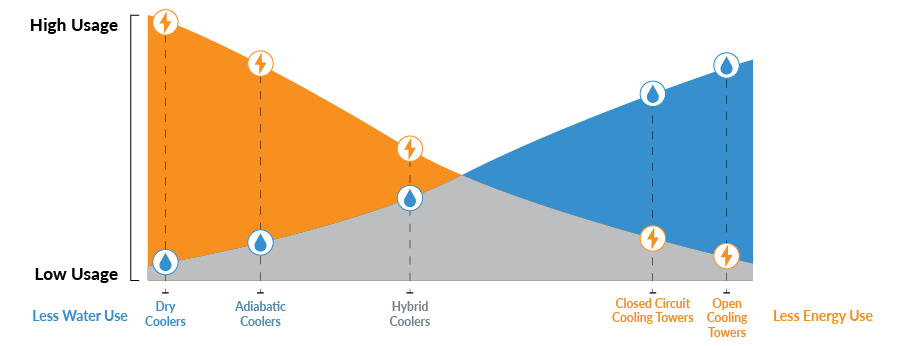
Source: Adapted from BAC, presented during Havtech’s “Trends in Data Center Heat Rejection” webinar.
A BAC data center case study shows how those tradeoffs can play out at scale, with water use, energy consumption, footprint and required water temperature all influencing the heat-rejection approach.
“Zero Water” is Not the Same as Zero Water Impact
A dry cooling system may use little or no on-site water, but it can use more electricity. Producing electricity may also use water, depending on the local power supply. So “zero water” at the data center does not always mean zero water use elsewhere.
Water availability changes the decision. A site with a strict water limit may need to rely more on dry cooling than one where water is readily available. The team needs to know whether the constraints include:
- No water service available
- A fixed daily, monthly, or annual water allowance
- A peak water-use limit
- Limited electrical capacity
- Available space for heat-rejection equipment
- Equipment sound limits
- A combination of these constraints
In one BAC project example, a strict water limit led to using both dry coolers and adiabatic equipment rather than a single heat-rejection type across the plant.
How Location Affects Data Center Heat Rejection Costs
BAC modeled a hypothetical data center with a constant 18 MW load under two operating conditions. The lower-temperature case used a 70°F supply and 88°F return; the higher-temperature case used a 106°F supply and 124°F return.
Using ASHRAE weather-bin data for Chicago, Dulles, and Amarillo, BAC compared an air-cooled chiller with water-cooled chillers paired with dry, adiabatic, and evaporative heat rejection.
The model estimated annual energy and water costs for each configuration.
Location Changes Data Center Cooling Operating Cost
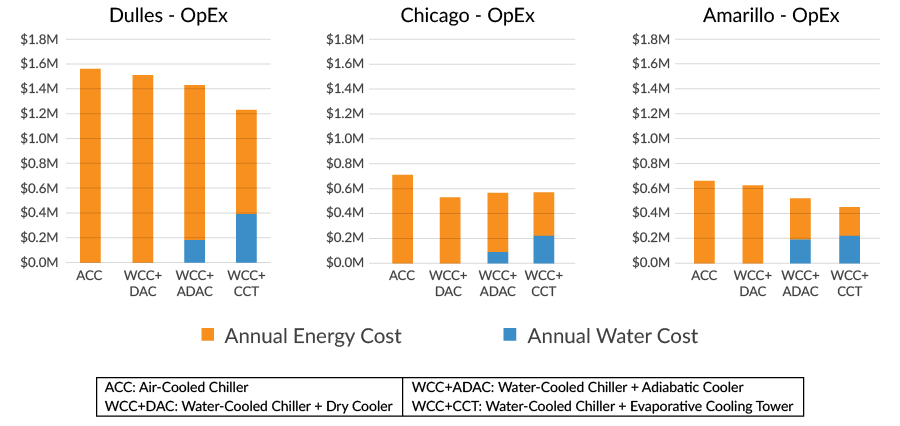
Source: BAC modeled 18 MW data center comparison presented during Havtech’s Trends in Data Center Heat Rejection webinar.
In BAC’s model, the configuration with the lowest combined energy and water cost varied by location. Climate changes the number of hours each configuration can operate most efficiently, along with water use and operating cost. Even when the cooling block is repeated across sites, the equipment still needs to be selected for each location’s conditions.
How Dry Cooling Affects Equipment Footprint
A larger allowable approach increases dry-cooler capacity. A tighter approach usually requires more heat transfer and, in many designs, more equipment.
For large data center sites, that can affect:
- roof or grade area
- number of units
- structural and electrical requirements
- installation labor
- service access
Outdoor equipment layout affects airflow and noise control, so both belong in the heat rejection design. Footprint belongs in the same comparison as energy and water use.
Factory-built dry-cooling blocks can shorten deployment time for large systems. Dustin identified speed to first compute and scalability as major customer priorities.
Planning a data center cooling project?
Havtech can help your team evaluate the temperature, water, energy, and space requirements that shape the heat-rejection design. Talk to an HVAC specialist about your project.
Author
Kevin Morin is President of Morin Hydronics, a Havtech company, bringing decades of experience in commercial HVAC and hydronic systems. His expertise includes cooling towers, heat exchangers, pumps, water treatment, and other hydronic equipment, with extensive experience supporting engineers, contractors, and building owners through equipment applications and system design. Kevin also has a long-standing relationship with Baltimore Aircoil Company and regularly shares his technical expertise through industry training and education.
 Kevin Morin
President
Morin Hydronics, a member of the Havtech Group
Technical Contributor
Dustin Cohick is Market Leader, Americas Data Center at BAC, where he focuses on cooling solutions for the rapidly evolving data center market. With more than 12 years of experience in HVAC and industrial cooling, Dustin has held roles spanning product management, sales, marketing, water treatment, dry and adiabatic cooling, and evaporative heat rejection. He brings a strong technical and commercial perspective to evaluating cooling technologies, water use, energy consumption, and system performance for mission-critical applications.
 Dustin Cohick
Market Leader, Americas Data Center
BAC (Baltimore Aircoil Company, Inc.)