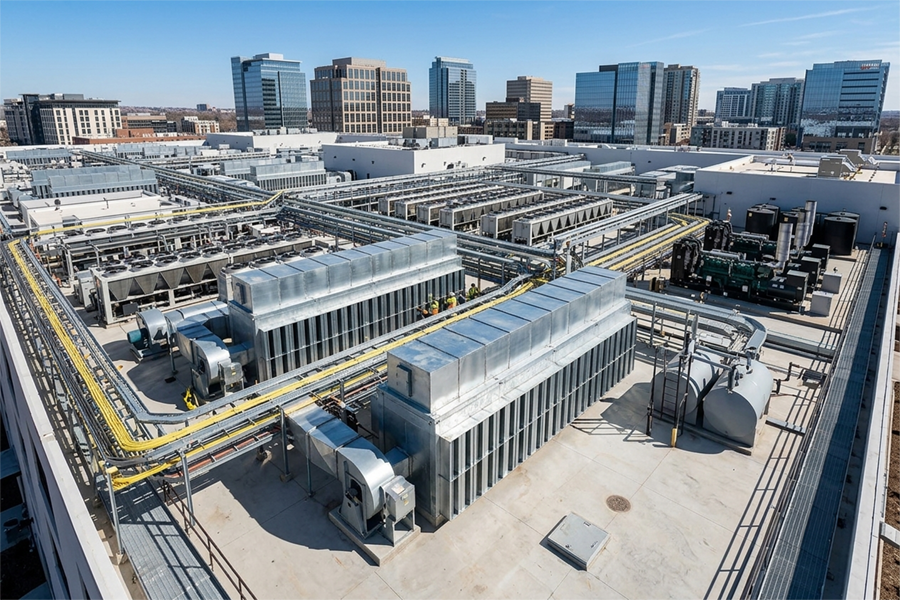
30% to 40% of data center energy use goes toward cooling. For a facility running continuously under high heat loads and strict uptime requirements, that number represents both the challenge and the opportunity. The challenge being that inefficiency in a data center isn’t always obvious. It can show up in rising energy costs, elevated PUE readings, and cooling systems working harder than necessary.
The opportunity lies in identifying where energy is being wasted and determining how to improve data center efficiency without putting uptime at risk. From cooling infrastructure and airflow management to controls, equipment sequencing, and setpoints, small changes to how a data center HVAC system operates can have a significant impact on energy use.
Why Is Data Center Energy Efficiency Harder to Achieve than Most Facilities?
Because cooling systems have to respond to changing IT loads while maintaining ideal operating conditions, creating an energy-efficient data center is complex. Cooling systems may need to maintain available capacity for peak loads and redundancy, even when that capacity isn’t actively needed.
These demands can make it difficult to reduce energy consumption without affecting how the system operates. Inefficiencies can come from equipment running at partial loads, unnecessary cooling capacity, poor airflow management, or controls that aren’t responding to actual conditions. Improving data center energy efficiency requires looking at how these systems operate together rather than optimizing one component alone.
Where Are the Biggest Energy Efficiency Opportunities in a Data Center?
With cooling accounting for a significant portion of energy use, reducing unnecessary cooling is one of the easiest opportunities to improve data center energy efficiency. Here’s what those opportunities look like:
- Airflow management: Reducing bypass air and hot air recirculation helps cooling reach IT equipment more effectively. Aisle containment can help by separating hot and cold air streams.
- Cooling system controls: Automated controls can adjust cooling output based on real-time conditions and IT loads rather than maintaining constant output.
- Equipment sequencing: Operating the appropriate number of cooling units for the current load can reduce unnecessary equipment runtime.
- Setpoint optimization: Adjusting temperature and humidity setpoints within ASHRAE-recommended ranges and IT equipment requirements reduces unnecessary cooling.
- Rack-level monitoring: Monitoring inlet temperatures and IT loads closer to the rack helps controls respond to changing heat loads without overcooling the entire space.
- Fan and pump optimization: Variable-speed fans and pumps adjust airflow and water flow as loads change instead of operating continuously at design conditions.
- Maintenance practices: Clean coils, clear filters, and properly calibrated sensors help cooling equipment operate as designed.
What Data Center Energy Efficiency Solutions Deliver Results?
The right data center energy efficiency solutions depend on your infrastructure, IT load, and where heat is concentrated. In some facilities, improving airflow, controls, equipment sequencing, or rack-level cooling may deliver better results than simply adding more cooling capacity.
The most effective approach usually combines a few targeted improvements that reduce wasted energy without compromising uptime.
How Do You Improve Efficiency Without Putting Uptime at Risk?
The answer is planning. Efficiency improvements need to be planned around redundancy requirements, existing operating conditions, and system dependencies. Changes to controls, setpoints, airflow, or equipment sequencing should be tested and commissioned before they become part of normal operation. And working with a partner who understands both the mechanical and controls sides of a data center means efficiency decisions are made with uptime at the forefront.
Looking for a partner who can improve your data center’s energy efficiency? Our experts are here to help you find a solution that fits your facility and your uptime requirements.