At a recent Virginia school facilities conference, one attendee raised a tough question: How do you justify spending money on HVAC inspections and reporting when you already have equipment that needs to be repaired?
At the October 2026 Virginia School Plant Managers Association (VSPMA) conference, Havtech asked attendees questions about how their divisions are preparing for Virginia’s indoor air quality (IAQ) requirements.
Responses from 22 participants affiliated with Virginia school divisions offer a look at where some facilities teams stand with their indoor air quality (IAQ) planning and what they need to move forward.
Virginia School IAQ Readiness Survey14 of 22Respondents said they need to establish a clearer IAQ baseline or aren’t sure where their division stands. |
Where Are School Divisions Starting with IAQ Planning?
Nine respondents said they needed to establish a clearer baseline. Another five weren’t sure where their division stood.
Knowing what to assess first was another challenge. Ten respondents said they were only somewhat sure which schools or HVAC systems to prioritize, while three said they didn’t know.
The uncertainty also surfaced during a VSPMA open forum. Participants discussed what an IAQ plan should include and how to get started. That conversation prompted a suggestion to develop a planning template that school divisions could use as a starting point.
Without a consistent picture of HVAC conditions across their schools, divisions may struggle to determine which buildings need attention first, estimate the cost of improvements, or explain those priorities to school leadership.
Funding Is the Biggest Barrier, but Not the Only One
When asked what was holding up their IAQ plans, respondents most frequently selected funding, followed by aging HVAC equipment and limited staffing or time.
What’s Holding Up School IAQ Plans?
Biggest barrier identified by survey respondents
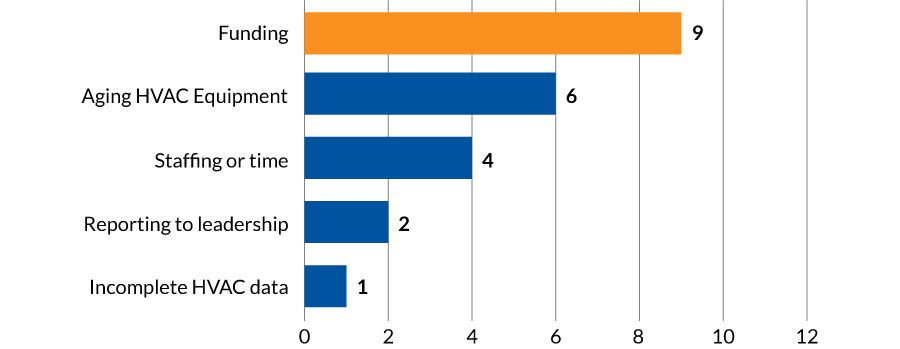
Source: Havtech VSPMA IAQ Readiness Quiz, October 2026. 22 respondents affiliated with Virginia school divisions.
These concerns reflect the budget dilemma raised at the conference. School divisions must make room for inspections while managing equipment repairs, replacements, and everyday maintenance.
Under Virginia Code § 22.1-141.5, school divisions must arrange HVAC inspections and evaluations at least once every four years for each public-school building. The law also requires written reports identifying necessary corrective actions.
For facilities teams already working with limited resources, the inspections add another expense and workload to plan for. And depending on what they find, additional repairs or equipment improvements may be needed.
What Would Help Facilities Teams Move Forward?
The survey also asked what kind of assistance would be most useful.
Ventilation and airflow verification topped the list, with eight respondents selecting testing, adjusting, and balancing (TAB) or better controls.
Six wanted help determining which HVAC improvements belong in the maintenance budget and which require capital investment. Another five identified reporting and documentation as their most immediate need.
Those needs are closely related. Ventilation testing may uncover an airflow problem that can be corrected through an adjustment or maintenance. Other findings may point to equipment that needs a more substantial investment.
The information also needs to be useful beyond the facilities department. School leaders need to understand what was found, which issues require action, and what those improvements may cost.
Turning School IAQ Inspection Results into a Workable Plan
The responses show why there isn’t a single starting point for every school division. Some are still establishing a baseline, while others are weighing inspection cost against aging equipment and existing maintenance needs.
The question is how to put the findings to work.
Before inspections begin, facilities teams and school leaders can consider how they’ll review the results, prioritize corrective actions, and determine what belongs in maintenance budgets versus future capital plans.
That groundwork can help make the inspection report more than a record of problems. It can become a useful part of planning what needs to happen next.
Preparing for Virginia’s school HVAC inspection requirements? Review Havtech’s Virginia School IAQ Law and Inspection Requirements for an overview of the requirements and steps to help your team get started.
About the Author
Mark Bailey is Havtech’s Vertical Market Leader for K-12 Schools. He works closely with school divisions to address HVAC challenges and plan improvements that make sense for their buildings and budgets. His approach reflects an understanding of the challenges schools face, from aging equipment and maintenance demands to indoor air quality, energy efficiency, and long-term facility planning.
 Mark Bailey
VML, K-12 & Higher Education
Havtech
About the Survey
Havtech conducted an informal, four-question IAQ readiness quiz at its exhibit booth during the October 2026 VSPMA conference. Attendees completed the quiz on their phones. The findings reflect 22 respondents affiliated with Virginia school divisions. Results represent a self-selected sample and are not representative of all Virginia school divisions.